
Reviewed · HISTORICAL TOURS
Shanghai Uncommon Historic Sites Tour
Shanghai’s story gets much stranger and more interesting once you leave the usual Bund and skyline route. This private tour links a fairy-tale mansion, an art deco slaughterhouse, a Ming-era defensive wall, and sites tied to the early Communist movement.
I like the unusual mix of places and the chance to see how foreign influence, old Chinese defenses, industry, and politics shaped modern Shanghai. I also like that the day includes an authentic dumpling lunch, a private vehicle, and a guide who can adjust the conversation to your interests. The main drawback is the $175 price, which is a serious outlay for one person, especially if you are more interested in famous landmarks than lesser-known history.
Key points
- 1933 Old Millfun: See Shanghai’s former municipal slaughterhouse, an eerie art deco complex now used for restaurants and shops.
- Moller Residence: Admire a 1936 mansion in the French Concession with brown tiles and Gothic and Tudor design.
- Private touring: Your own group travels by air-conditioned vehicle, with pickup offered and no strangers joining you.
- Layered history: The route moves from Ming defenses to Zhou Enlai, the Communist Party, colonial architecture, and early twentieth-century engineering.
- Authentic lunch: A dumpling meal is included, giving the day a practical pause as well as a taste of local food.
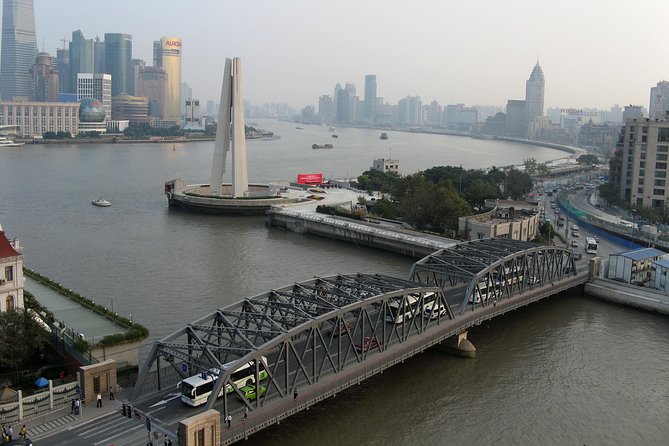
- Waibaidu Bridge: Finish with China’s first all-steel bridge and its surviving camelback truss design.
Why this Shanghai route feels different
This is not a checklist of Shanghai’s grandest sights. It is a day built around clues.
At the Moller Residence, you see how a wealthy shipping businessman expressed himself through a highly personal mansion. At 1933 Old Millfun, you get an industrial building whose original purpose was far less romantic. At the ancient city wall, you are reminded that Shanghai once feared attack by sea. Later, the former residence of Zhou Enlai and the Second National Congress site connect the city to China’s modern political story.
I like that the route does not force every stop into the same historical box. Shanghai was a port, a commercial center, a military target, a revolutionary meeting place, and a city of grand private fortunes. You get pieces of all of those identities in one day.
The private format matters here. These are places where a guide can explain what you are seeing rather than simply ushering you from one photo stop to the next. Peggy is one named guide associated with this experience. She is described as speaking excellent English, taking photos, and helping shape a wider Shanghai visit. Since the company may assign a different guide, treat Peggy as a possible guide rather than a guarantee.
Other history to see in Shanghai:
- Tour of Jewish Shanghai led by a Jewish History Expert
★ 5.0 · 106 reviews - 4-Hour Private Shanghai Art and History Tour
★ 5.0 · 8 reviews - Private Full Day Tour: Shanghai Colonial History Tour
★ 5.0 · 6 reviews
Moller Residence and the French Concession
Your first stop is the Moller Residence, a colonial-era mansion in Shanghai’s French Concession. Eric Moller, a British shipping businessman who made his fortune in shipping, built the house in 1936.
The exterior is the reason to come. Brown roof tiles and a mixture of Gothic and Tudor features give the building a storybook appearance. It feels unlike the formal European villas you might expect from a colonial neighborhood because the design is so distinctive and theatrical.
You get about an hour here, enough time for the guide to explain the building and its owner without turning the visit into a rushed photograph. The admission charge is listed as free, which helps the value of the stop.
There is also a useful limitation to understand. This is not presented as a long museum visit with a large collection of objects. The appeal is the architecture, the setting, and the story of the person who commissioned it. If you enjoy buildings and city history, this will likely be one of the strongest early stops. If interiors are your main reason for visiting, ask your guide what access is available on the day.
The French Concession setting also gives the tour an early lesson in Shanghai’s layered identity. You are looking at a house shaped by foreign commercial wealth, but it belongs to a Chinese city whose story did not begin with the foreign concessions. The rest of the day makes that contrast clearer.
1933 Old Millfun, an art deco slaughterhouse
1933 Old Millfun is the day’s most unexpected building. The complex once housed the Shanghai Municipal Council Slaughterhouse, described as the largest slaughterhouse in Shanghai. Today, restaurants and shops occupy the site.
The old function is part of the fascination. You are not simply admiring polished art deco lines. You are looking at a building designed for a hard, practical industrial purpose, then reused for modern urban life. That tension gives the site its unusual mood.
Allow about an hour. The architecture is the focus, with concrete passages, unusual forms, and a layout that rewards looking upward and around corners. The building has an eerie quality, but it is not an abandoned ruin. Its current restaurants and shops make it easier to visit than a sealed historic structure.
I like this stop because it explains something important about Shanghai: the city keeps changing the use of its buildings. A place built for municipal industry can become part of the food, shopping, and arts scene. Your guide can help separate what is original from what belongs to the newer use.
This is also a good place for photos, though the light and angles may be uneven. Wear shoes suited to a full day on your feet. The tour involves several stops, and an hour in a large building can pass quickly if you are paying attention to the architecture.
Zhou Enlai’s former residence
The next stop shifts from architecture to political history. The former residence of Zhou Enlai is a three-story French-style house built in the 1920s.
Zhou Enlai served as the first Premier of the People’s Republic of China from 1949 until his death in 1976. Before that later national role, this Shanghai house served as the Shanghai office of the delegates of the Communist Party of China. That makes the building useful for understanding the period when political work was being organized through private-looking urban residences.
You have about an hour here. The value comes from the connection between an ordinary-looking city house and major events in twentieth-century China. The French style also links this stop back to the Moller Residence, though the political meaning is entirely different.
I would give this stop your full attention even if you do not usually seek out political museums. Shanghai’s modern story cannot be understood through architecture alone. The city’s streets and houses were also places where people planned, argued, organized, and made decisions that later affected the whole country.
The information provided does not promise a particular display, room access, or special exhibition, so keep expectations practical. Your experience will depend on what areas are open and how your guide presents the site. The private format is useful because you can ask for more background if this part of the day interests you.
Same city, a completely different day:
- Authentic Local Food Tour in Central Shanghai
★ 5.0 · 1,382 reviews - Zhujiajiao Water Town and Shanghai City Private Day Tour
★ 5.0 · 1,016 reviews - Private Shanghai Full Day City Tour with Old and New Highlights
★ 5.0 · 995 reviews - Shanghai: Hop-on Hop-off Bus Ticket and Optional Attractions
★ 3.4 · 692 reviews
The Ming city wall near Renmin Lu
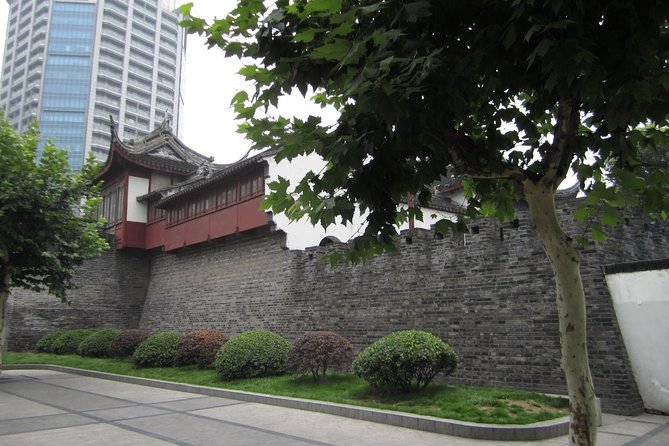
The Shanghai Ancient City Wall is a short stop, about 30 minutes, but it reaches much further back in time than the other sites.
In 1553, during the Ming Dynasty, Shanghai built a wall to defend the city against Japanese pirates. The wall followed the course of today’s Renmin Lu and Zhonghua Lu. It measured about 8.1 meters high and extended 4.8 kilometers around the old city.
Only a small surviving section remains, so this is not a walk along a complete medieval fortification. That is the key point to understand before you arrive. The stop works as a physical reminder of the old city’s defensive edge, while the modern streets around it show how completely Shanghai has grown beyond those boundaries.
I like the contrast here. Earlier stops show private wealth and industrial planning. This one shows a city protecting itself. The wall also corrects the easy idea that Shanghai is mainly a modern commercial creation. Its urban roots reach back through the Ming period and earlier local development.
Because the visit is brief, listen for the location clues. Renmin Lu and Zhonghua Lu now carry modern city life, but their routes help you picture the old wall’s footprint. A guide is especially useful here because the remaining structure alone may not explain the full scale of what once stood around the city.
The Second National Congress site
The Site of the Second National Congress of the Communist Party of China gives the day its clearest connection to the early Communist movement.
The congress took place in Shanghai from July 16 to July 23, 1922. It was an important party meeting that helped confirm and develop the organization’s early direction. You spend about an hour here.
This is a focused political-history stop, not a scenic landmark. I would recommend it most strongly to anyone interested in the formation of modern China, revolutionary history, or the way small meetings can carry national consequences. If your interests lean only toward architecture, this may feel more specialized than the other locations.
Still, it belongs in the route because it connects directly with Zhou Enlai’s former residence. One site shows where political delegates worked in Shanghai. The other marks a major national party gathering. Together, they give the political part of the tour more shape than either stop would provide alone.
Your guide can also help place these events in the wider sequence of the city’s development. The tour does not treat history as a collection of unrelated dates. It moves from a defensive Ming city to a treaty-port-era commercial center and then to a place of organized political change.
Waibaidu Bridge and Shanghai’s steel age
The final listed stop is Waibaidu Bridge, also known as Garden Bridge in some English references, though the supplied tour information identifies it by its Chinese name. It is the first all-steel bridge in China and the only surviving example of a camelback truss bridge in the country.
The present bridge opened on January 20, 1908. Those details matter because this is more than a crossing with a nice view. Its structure records Shanghai’s early twentieth-century engineering and international connections.
The bridge is a fitting finish. After seeing a mansion built by a shipping fortune, an industrial complex, old defenses, and political sites, you end with infrastructure. Bridges tell you how a city connects its districts, trade, people, and daily routines. Waibaidu Bridge also brings the tour back toward the better-known historic center without repeating the standard sightseeing program.
The provided schedule does not specify the time spent here, so your guide may shape the visit around the day’s traffic and timing. You should expect the bridge to be an exterior stop rather than a museum visit. Its value is in the structure, the story, and the urban setting.
Dumplings, private transport, and the pace of eight hours
The tour lasts about eight hours and begins at 9:00 a.m. Pickup is offered, and the group travels in an air-conditioned vehicle. Lunch is included, specifically an authentic dumpling lunch, along with entrance fees and taxes.
These details make a real difference in Shanghai. Six historic stops spread across the city would be tiring if you had to manage every transfer yourself. A private vehicle gives you a place to regroup between sites and keeps the day from becoming a sequence of transit decisions.
The lunch is not just a price extra. A dumpling meal gives you a local food experience without requiring you to spend part of the day searching for a restaurant. The tour information does not name the restaurant or specify the menu, so do not book this expecting a particular famous dining room or a cooking lesson.
The private format means only your group participates. That is helpful if you want to ask questions about twentieth-century politics, architecture, or the city wall without worrying about holding up a large group. It is also useful for mixed-interest groups, since the guide can spend more time at the stops that matter most to you.
The pace is full but reasonable on paper. Several stops receive about an hour, while the city wall receives 30 minutes. You will need to stay ready to move. This is not an experience built around lingering for half a day at one museum.
Is $175 a fair price?
The listed price is $175 per person. That is not a bargain-priced city orientation, but the value looks better when you count what is included: roughly eight hours, private guiding, an air-conditioned vehicle, pickup, lunch, entrance fees, and a route that would be difficult to reproduce efficiently in one day.
The price is easiest to justify for a solo visitor or a small group that values private transport and tailored discussion. Group discounts are offered, though the exact reduction is not specified. For two or more people, the cost may feel more reasonable because you are buying a private day rather than several separate admissions and transfers.
It is less appealing if your main goal is Shanghai’s standard highlights. You could spend the same time on famous landmarks and see more instantly recognizable sights. This tour earns its price through context and access to unusual places, not through a long list of headline attractions.
Tips are recommended and are not included. Build that extra cost into your budget. Free cancellation is available when you cancel at least 24 hours before the 9:00 a.m. start time. Changes or cancellations inside that window are not accepted for a refund.
Who should book this tour?
I would choose this day if you have already seen, or deliberately want to skip, the usual Shanghai route. It suits people who enjoy architecture, political history, city planning, and the odd detail that makes a place memorable.
It is also a good choice for a first visit if you want a guide to explain the city rather than simply point out famous buildings. The itinerary gives you a broad historical frame, from the Ming Dynasty to the twentieth century and the present reuse of old structures.
Families and mixed-age groups may appreciate the private vehicle and the variety of stops, though the day still includes several hours of walking and standing. Service animals are allowed, and most people can participate. The tour is near public transportation, but its private vehicle reduces the need to navigate the network between stops.
You should think twice if you dislike political history or prefer long, relaxed meals and extended time at one site. The Second National Congress location and Zhou Enlai’s residence require attention to context. The route is rewarding when you want to understand how Shanghai developed, but less satisfying if you only want views and shopping.
Final call: an excellent choice for curious Shanghai visitors
Book this tour if you want the city’s less obvious stories and appreciate a guide who can connect buildings, politics, defense, trade, and daily life. The Moller Residence and 1933 Old Millfun provide memorable architecture, while the city wall, Zhou Enlai’s residence, Communist Party site, and Waibaidu Bridge give the day historical range.
Skip it if your priority is the Bund, the Shanghai Tower, or other headline sights. At $175 per person, this is a focused private history day, not a general introduction to every famous corner of Shanghai.
For the right audience, the unusual route is the point. You finish with a better sense of the city as a place built in layers, not just a skyline beside the Huangpu River.
FAQ
What time does the tour begin?
The tour starts at 9:00 a.m.
How long does the experience last?
The tour lasts approximately eight hours.
Is hotel pickup available?
Pickup is offered, although the supplied information does not specify the exact pickup locations.
Is this a private tour?
Yes. Only your group participates in the activity.
Is lunch included?
Yes. An authentic dumpling lunch is included, along with an air-conditioned vehicle, entrance fees, and taxes.
Can I cancel for a full refund?
Yes, if you cancel at least 24 hours before the experience start time. Cancellations or changes made less than 24 hours before the start are not accepted for a refund.
New reviews from Shanghai
- Shanghai To Beijing Bullet Train Ticket with Local Private Transfer★ 5.0 · 12 reviews
- Shanghai Spicy Food Tour★ 5.0 · 3 reviews
- Shanghai Tower Observation Deck 118 floor Tickets Pre-booking.★ 5.0 · 4 reviews
- Shanghai Pudong airport transfer to Disneyland:Private with Meet & Great service★ 5.0 · 3 reviews
- Pudong Airport to Hangzhou: Private with Meet and Greet Service★ 4.5 · 4 reviews
- Private Transfer: Hotel to Shanghai Wusongkou Cruise Terminal (Baoshan Port)★ 3.5 · 6 reviews
- Shanghai Pudong International Airport (PVG) to Shanghai Hotel★ 5.0 · 4 reviews
- Shanghai Pudong and Shanghai Hongqiao Airport to Hotels Transfer★ 5.0 · 4 reviews
Historical Tours, compared.
Between Capitalism & Communism: Hong Kong History Tip Based Tour
Read our review →
Beijing Historical Tour II including Summer Palace, Lama Temple & Panda Garden
Read our review →
Beijing Historical Tour I – Forbidden City, Tiananmen Square & Temple of Heaven
Read our review →
Tour of Jewish Shanghai led by a Jewish History Expert
Read our review →
Beijing Historic City Guided Walking Tour + Calligraphy Creation
Read our review →
Beijing Culture: Tea Ceremony, Heritage Instrument & Calligraphy
Read our review →
2-Hour Beijing Private Forbidden City Tour: History & Highlights
Read our review →
Xi’an Full Day Sightseeing Tour – Shaanxi History Museum, Big Wild Goose Pagoda, Ancient City Wall
Read our review →Browse the lists this tour appears in