
Reviewed · HISTORICAL TOURS
Chongqing 1949 Ticket Epic Historical Spectacle
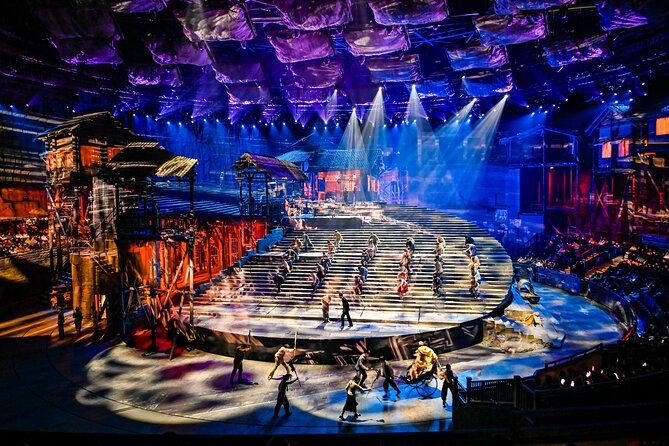
Chongqing 1949 turns a chapter of the city’s revolutionary past into a huge stage event. More than 700 live performers work with a rotating set, water, fire, and special effects, so the action can appear around you rather than in one flat frame. I like the scale, and I like that the production gives Chongqing’s 1949 story a strong local setting at Ciqikou.
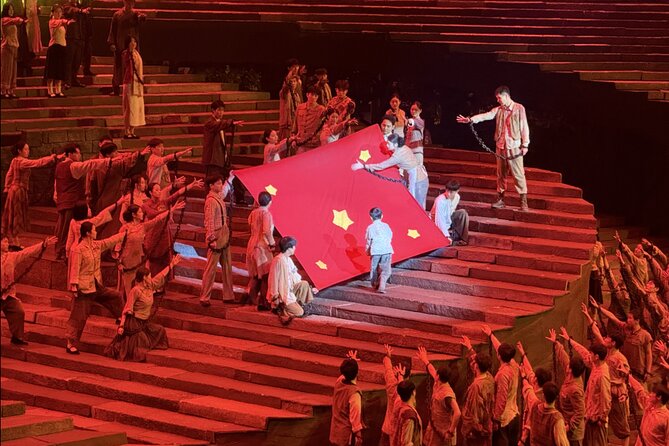
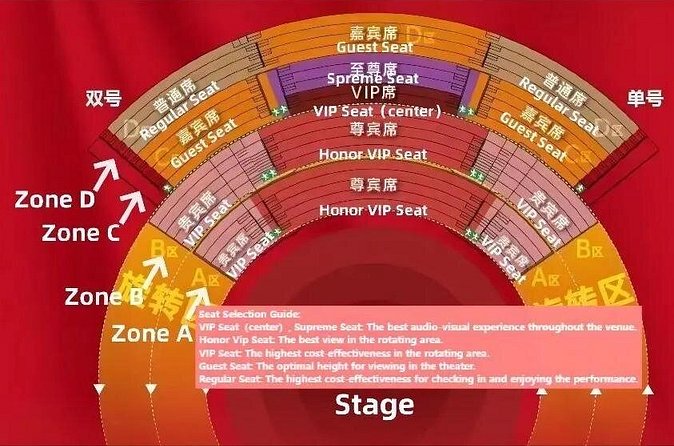
The main thing to consider is language. The show is built around visual action and choreography, but much of the story is in Chinese. An English-speaking audience member found a translator headset useful and was still able to follow the production. Also pay attention to seating: Section B generally offers the strongest viewing angles, while Sections C and D use fixed seats.
Key points to know before you book
- A rotating stage changes your view: Sections A and B use rotating seats, giving the performance a more unusual physical scale.
- More than 700 performers fill the production: Expect a large historical spectacle rather than a small theater presentation.
- Section B is usually the smart seat choice: It generally provides a better overall angle and visual experience.
- Water, fire, and special effects shape the story: The technology is part of the show, not just decoration.
- The performance lasts about 1 to 2 hours: It fits reasonably well into an afternoon or evening in Chongqing.
- Your ticket is collected at Ciqikou: The stated start time is 4:00 pm, at the Ciqikou Residential District in Shapingba District.
A 1949 story told on a very large stage
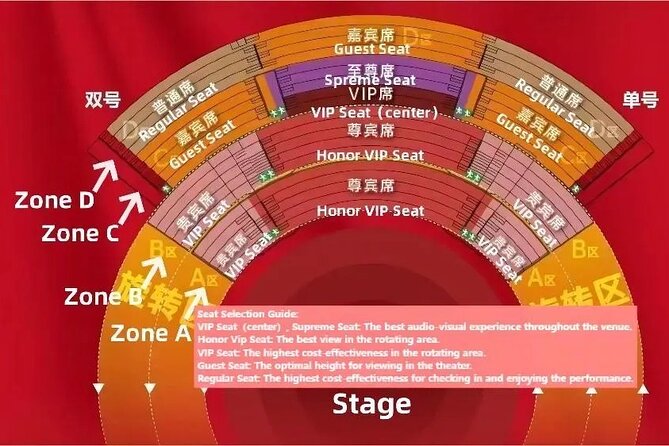
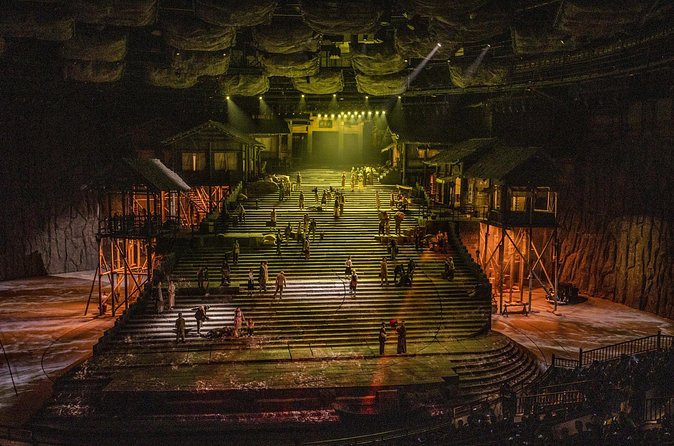
Chongqing 1949, also called the 1949 Grand Theater, presents the city’s important events and spirit in 1949. The subject is serious, but the format is anything but a quiet museum lecture. You get dramatic movement, large scenes, changing viewpoints, and stage machinery designed to make history feel immediate.
I like this approach for a city such as Chongqing. A conventional historical exhibit can give you dates and names, while a large performance can suggest the emotion and pressure of a particular period. You are not simply sitting in front of a backdrop. The stage itself moves, and the scenes are arranged in more than one direction.
That scale also tells you what kind of evening this is. You should not expect a small, intimate play built around a few actors and detailed conversation. This is a mass production, with choreography and visual effects doing much of the storytelling. If you enjoy theater that works through movement, sound, and spectacle, the format should suit you well.
If you prefer English narration, ask about a translator headset. The available account from an English-speaking audience member points to an important practical detail: the visual performance can still carry the story, but translation support helps you catch the spoken content and historical context.
Other history to see in Chongqing:
- 2Day Wulong Karst Park+Dazu Carvings World Heritage Private Tour
★ 5.0 · 4 reviews - Chongqing: Historical Blocks, Temple, and Mountain Tour
★ 5.0 · 4 reviews - Between Capitalism & Communism: Hong Kong History Tip Based Tour
★ 5.0 · 234 reviews
Why the rotating seats matter
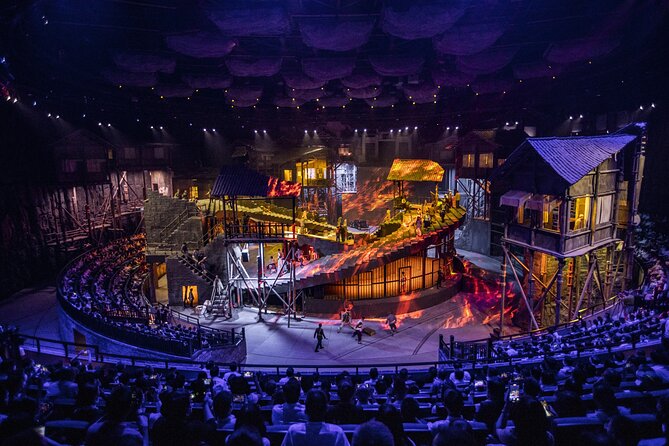
The show’s main technical feature is its 360-degree rotating stage. Seats in Sections A and B rotate, while Sections C and D are fixed. That difference matters more than a simple label on a seating chart.
With rotating seats, your position changes as the production moves through its scenes. Instead of watching every moment from one fixed angle, you can be turned toward different sections of the set. This helps the production create a wider sense of place and lets the stage machinery become part of what you see.
I would give Section B serious consideration. It is generally described as offering the better viewing angle and overall visual experience. The exact arrangement depends on the theater’s seating plan, so check the current chart before choosing if seat selection is available.
Sections C and D are not necessarily poor choices. Fixed seating may suit you if you prefer a stable position or if those seats are the available option. Still, the rotating design is one of the main reasons to attend this production, so the difference between rotating and fixed sections is worth understanding before you pay.
The use of rotating seats can also affect how you watch. You may find yourself paying attention not only to the performers but also to the way the production places you within each scene. That is a stronger theatrical idea than simply adding a large screen or louder sound system.
More than 700 performers, and what that means
The production uses more than 700 live performers. That figure gives you a clear sense of its scale. Large groups can create the feeling of a city, a public gathering, or a major historical moment in a way that a small cast cannot.
The choreography is one of the main attractions. You can expect coordinated movement and dramatic staging rather than a plain spoken account of 1949. If you enjoy large formations and carefully timed action, this will likely be one of the show’s strongest features.
There is a tradeoff. A cast this large can make individual characters harder to follow, especially if you are also working through a language barrier. The performance seems designed to communicate through the whole stage picture, not only through one central character’s personal story.
That is why a translation headset can be useful. You can follow the basic emotional direction from the action, then use translation to catch more of the spoken narrative. I would not treat the language issue as a reason to skip the show, but I would plan for it rather than assume every detail will be clear without help.
Water, fire, and modern stage technology
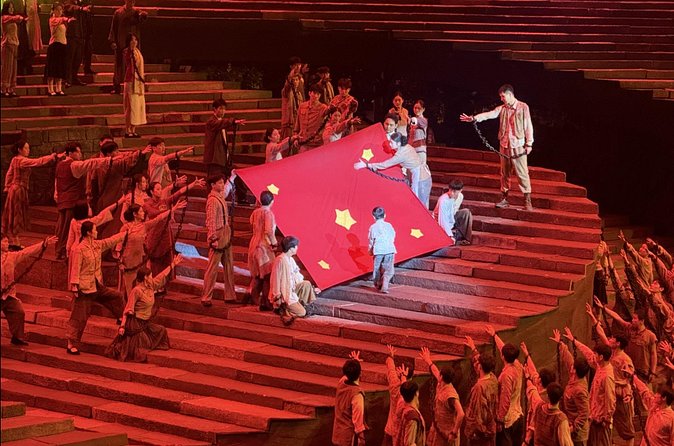
Water and fire are built into the production, along with other special effects. These elements give the show a physical force that ordinary theater cannot match. They can change the mood of a scene quickly and make the historical setting feel active rather than static.
I like that the technology appears to serve the story. The stage machinery, rotating seats, water, and fire are not separate attractions added beside the history. They help create the sense of events unfolding across a much larger space.
At the same time, special effects can dominate your attention. If you are mainly interested in careful historical explanation, the production may feel more theatrical than academic. You will likely get the most from it if you see the spectacle as a way to approach Chongqing’s past, not as a substitute for a museum or detailed guided history lesson.
The show’s technical side is also a good reason to avoid rushing in at the last minute. Arriving with enough time to redeem your paper ticket and find your section gives you a better chance to settle in before the stage action begins. The listed start time is 4:00 pm, and the full experience takes about 1 to 2 hours.
A few more days out in Chongqing worth the ticket
- Chongqing: 520m-high Eye Skyview Deck Ticket for Adult
★ 3.9 · 19 reviews - Beijing: Forbidden City Tour(Group/Private)-Tickets Included
★ 4.8 · 7,974 reviews - Beijing: Mutianyu Great Wall Daily Tour with Ticket & Lunch
★ 5.0 · 3,056 reviews - 4-Hour Small Group Tour to Forbidden City with Entry Tickets
★ 5.0 · 1,863 reviews
Starting at Ciqikou in Chongqing
The ticket redemption point is in the Ciqikou Residential District, Shapingba District, Chongqing, postal code 400038. The experience information identifies Ciqikou, also known as Porcelain Port, as the stop connected with the show.
This location matters because Ciqikou gives the performance a city-based setting rather than placing it in an isolated theater with no connection to the surrounding area. You can treat the show as part of a visit to this Chongqing district, though the provided information does not specify a guided walking program or additional sightseeing stops.
The meeting detail is simple: start time at 4:00 pm, with ticket redemption at Ciqikou. Admission is included in the purchase. No guide service, meal, transportation, or other extra service is listed, so you should plan those parts yourself.
The area is near public transportation, which makes the theater practical to reach. Since the exact transport route depends on where you are staying in Chongqing, check your route before the afternoon begins. The important point is that this is a theater ticket with a stated redemption point, not a door-to-door tour.
Is $41.06 a fair price?
The price is $41.06 per person. That is not a bargain theater ticket in every city, but the value depends on what you want from an evening in Chongqing.
You are paying for a large-scale production with more than 700 performers, rotating seating in selected sections, special effects, and a performance lasting about 1 to 2 hours. If you enjoy major stage productions, that package can make the cost reasonable. The rotating theater setup alone gives the experience a format you will not get from a standard historical presentation.
I would compare the ticket with the cost of other evening entertainment in Chongqing, not only with the price of a museum admission. The show is designed to be a major visual event. If you prefer low-cost independent sightseeing, the ticket may feel expensive. If you want a planned cultural performance with a strong sense of place, it may be a sound use of your budget.
Seat location affects the value. Section B generally has the best viewing angle, so I would prioritize it if the price difference is small or if you have a choice. Sections A and B use rotating seats, while C and D are fixed. The exact arrangement should be checked against the theater’s current seating chart.
The booking pattern suggests people often secure tickets about 15 days ahead. That does not guarantee that you must book two weeks early, but it is a useful planning signal for a fixed-date theater event. The ticket is non-refundable and cannot be changed after purchase, so only book once your schedule is firm.
Who will enjoy Chongqing 1949 most
I would recommend this show to you if you like historical events presented through theater, choreography, and technical effects. It also suits anyone who wants a large evening attraction rather than another quiet indoor exhibit.
It can work well for families and mixed-age groups because the visual action gives you something to follow even when every spoken line is not understood. The setting, rotating stage, and fire and water effects provide clear points of interest for people who may not normally choose a history-focused performance.
English-speaking visitors can still enjoy it, but I would make translation support a priority. The available experience with a translator headset suggests that you can follow the main story more effectively with one. Without language help, the physical action remains accessible, but some historical meaning may be lost.
You may want to choose a different activity if you dislike loud, large-scale productions or if you want a fully English-language presentation. You should also think twice if your schedule is uncertain, since the ticket cannot be refunded or amended.
Timing, ticket handling, and practical planning
The stated start time is 4:00 pm, and the show runs for approximately 1 to 2 hours. That makes it possible to place the performance into an afternoon plan, but you should leave room to reach Ciqikou and redeem the paper ticket.
Your ticket is described as a paper ticket. Keep the redemption information handy and allow time at the Ciqikou Residential District before the performance. The experience does not list hotel pickup, transfers, meals, or personal guiding, so none of those should be assumed to be part of the price.
Confirmation is provided at booking, and the theater is near public transportation. Most people can participate according to the supplied information. If you need a particular seat type or have a question about the rotating sections, check the seating chart and theater arrangements before booking rather than relying on a last-minute request.
The average advance booking point is 15 days. That is especially relevant if your Chongqing schedule includes several fixed reservations. Because the ticket is non-refundable, keep your plans stable before you commit.
My overall view of the performance
The strongest reason to choose Chongqing 1949 is its combination of local history and serious stage machinery. The show gives you a way to encounter Chongqing’s 1949 story through a full theater event, not just through labels on a wall.
I especially like the rotating stage and the scale of the cast. More than 700 performers create a sense of collective action, while the changing seats give the production a physical structure that ordinary theater lacks. The water, fire, and other effects add force, though they may appeal more to fans of spectacle than to people seeking quiet historical detail.
The language question is real but manageable. A translator headset can help English-speaking audience members follow the story, and the visual design does some of the work. Still, do not expect every spoken detail to be available in English unless translation support is arranged.
Should you book Chongqing 1949?
Book it if you want a major theatrical presentation of Chongqing’s 1949 history and value scale, choreography, and stage technology. Try for Section B if the seating choice is available, and plan to use a translator headset if you need English support.
Skip it if you want a flexible, refundable plan, a small traditional play, or a fully English-language history experience. At $41.06, the ticket makes the most sense when you are specifically interested in a large visual production and can commit to the 4:00 pm appointment at Ciqikou.
FAQ
Where does Chongqing 1949 take place?
The ticket redemption point is in the Ciqikou Residential District, Shapingba District, Chongqing, China, postal code 400038.
What time does the experience start?
The stated start time is 4:00 pm.
How long does the performance last?
The performance lasts approximately 1 to 2 hours.
Which seating section generally offers the best view?
Section B generally offers better viewing angles and a stronger overall visual experience. Sections A and B use rotating seats, while Sections C and D use fixed seating.
Is admission included?
Yes. Admission is included in the ticket price.
Can the ticket be refunded or changed?
No. The experience is non-refundable and cannot be changed for any reason after booking.
New reviews from Chongqing
- 4D3N Victoria 5-star Yangtze Cruise★ 5.0 · 3 reviews
- Yangtze River Cruise from Chongqing to Yichang Downstream in 4 Days 3 Nights★ 4.5 · 8 reviews
- Private Customized Tour: Chongqing City Highlights in One Day★ 5.0 · 11 reviews
- Dazu Ancient Rock Carvings Private Tour Extension★ 5.0 · 24 reviews
- Private Chengdu Highlights Day Trip: Panda Base and City from Chongqing by Train★ 4.5 · 9 reviews
- Private Day Tour to Ciqikou, Liziba, Jiefangbei etc. in Chongqing★ 4.5 · 5 reviews
- Chongqing private luxury city tour: Must-sees All in One★ 5.0 · 39 reviews
- Chongqing Wulong: All inclusive luxury private trip to 2 spots★ 5.0 · 26 reviews
Historical Tours, compared.
Between Capitalism & Communism: Hong Kong History Tip Based Tour
Read our review →
Beijing Historical Tour II including Summer Palace, Lama Temple & Panda Garden
Read our review →
Beijing Historical Tour I – Forbidden City, Tiananmen Square & Temple of Heaven
Read our review →
Tour of Jewish Shanghai led by a Jewish History Expert
Read our review →
Beijing Historic City Guided Walking Tour + Calligraphy Creation
Read our review →
Beijing Culture: Tea Ceremony, Heritage Instrument & Calligraphy
Read our review →
2-Hour Beijing Private Forbidden City Tour: History & Highlights
Read our review →
Xi’an Full Day Sightseeing Tour – Shaanxi History Museum, Big Wild Goose Pagoda, Ancient City Wall
Read our review →Browse the lists this tour appears in