
Reviewed · WALKING TOURS
Pingyao Ancient City Full-Day Walking Tour
Pingyao’s best stories are written into its walls, courtyards, old shops, and government offices. This eight-hour private walking tour gives you a clear way through one of China’s best-preserved ancient cities, with an English-speaking guide to explain what you are seeing rather than leaving you to guess.
I like the flexible, private format, especially for families or small groups of up to six. I also like that guides such as Mike have adjusted the pace for photos, rest stops, and lunch, while Lisa has helped visitors with practical matters such as show tickets. The main drawback is cost: at $229 per group, you also pay admission, meals, and any needed transfers.
Key points to know
- Walk above the rooftops: Sections of Pingyao’s brick-and-stone city wall give you a useful view of the old town and its low-rise courtyard homes.
- See China’s early banking center: Rishengchang Exchange Bank explains how money moved across China before modern banks.
- Enter a working government compound: The Yamen includes offices, courtrooms, living quarters, a garden, and a prison.
- Ask for a personal pace: Your private guide can pause for photos, rest, lunch, or places that match your interests.
- Plan for extra costs: Admission is 125 RMB per adult, half price for children, with the guide admitted free.
- Best for first-time visitors: The tour links the major sights while adding stories about daily life, architecture, symbolism, and local figures.
Starting inside Pingyao’s old city
Your guide meets you in the lobby of your Pingyao hotel if you are staying inside the ancient city. If your hotel is outside the old town, the meeting point is arranged inside Pingyao instead. This matters because the historic area is best explored on foot, and the tour does not include a separate transfer service.
The full experience lasts eight hours, with about six hours set aside for sightseeing. That gives you a substantial day in the old city, though you should expect a steady amount of walking over old streets and through large historic compounds.
The private format is one of the tour’s strongest features. You are not tied to the pace of a large group. Guides have been able to stop for photographs, answer extra questions, and let people rest when needed. If you care about architecture, local customs, photography, old banking, or imperial-era education, tell the guide at the start so the day can lean in that direction.
English and Chinese are available. The guide is included, but admission is not. You pay 125 RMB per adult for the city sights, children pay half price, and the guide enters free. Your guide helps you buy the tickets on the day.
Other walks around China:
- Beijing Hutong Walking Food and Beer Tour at Hidden Restaurants
★ 5.0 · 1,132 reviews - Private Beijing Walking Tour of the Forbidden City with 7 Options
★ 5.0 · 675 reviews - Dark Side of Hong Kong – Kowloon Caged Homes Walking Tour
★ 5.0 · 418 reviews
Walking the Pingyao city wall
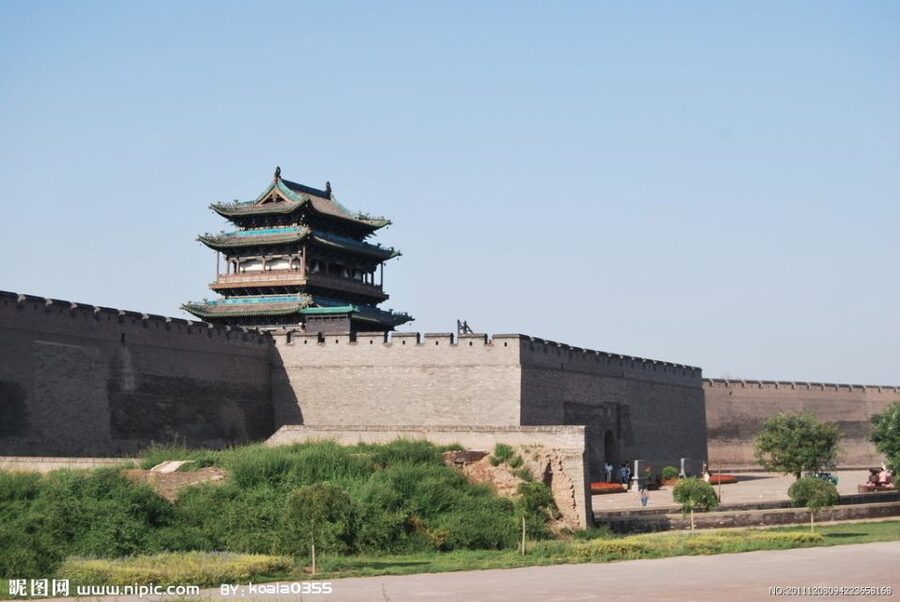
The city wall is a strong opening because it helps you understand Pingyao from above. Built with bricks and stones, it surrounds the old town and gives you views across rows of tiled roofs, narrow lanes, and enclosed courtyards.
Most buildings inside the historic city are low-rise. From the wall, you can see how tightly the homes, shops, temples, offices, and lanes fit together. This is more than a photo stop. The elevated view gives you a quick sense of Pingyao’s scale and layout before you spend hours at street level.
The wall also helps explain why the old city feels so contained. You can look down into domestic courtyards and see the repeated pattern of tiled roofs and brick construction. The design is practical, but it also reflects the way daily life once centered on enclosed family compounds.
Your guide can add context about the wall and the city’s structure. One especially useful part of the guiding is learning how the streets, buildings, and wall worked together, rather than seeing each place as an isolated monument.
The wall is not the whole day, and you will not walk every section. The route uses parts of it for views and orientation. Wear comfortable shoes, and keep in mind that a wall walk adds stairs and uneven surfaces to an already active day.
Rishengchang and the story of Chinese banking
At Rishengchang Exchange Bank, the tour turns from military protection to commerce. Rishengchang is known as China’s first exchange bank, and its old compound shows how money-handling worked before modern banking networks.
The value of this stop lies in the setting. Instead of reading a short label about finance, you walk through the old rooms and courtyards where business was organized. The buildings help you picture clerks, merchants, records, security measures, and long-distance trade.
This is also where a good guide can make a major difference. The architecture alone may look like another collection of rooms, but the right explanation connects the compound to the movement of money across a large country. Ask about how the exchange bank served merchants and why security mattered so much.
The stop works especially well if you enjoy social and economic history. It shows that Pingyao was not simply a preserved residential town. It was a serious commercial center with institutions that helped business operate across regional boundaries.
The Ancient Security Guard Company
Pingyao’s commercial success required protection. The Ancient Security Guard Company was the city’s private armed escort organization, and it was one of the two most famous such companies during the Ming and Qing periods.
This visit adds useful balance to the banking stop. Rishengchang explains how money was exchanged, while the security company points to the risks involved in moving wealth. Together, the two sites show the practical side of trade: money needed to travel, and merchants needed people capable of guarding it.
The attraction is also a reminder that private organizations once handled duties that might now be associated with banks, police, or security firms. Your guide can explain how the escort company fit into Pingyao’s commercial life and why it became important in the city’s history.
The information can feel dense if you try to absorb every name and date. I would focus on the larger picture: Pingyao’s old economy depended on finance, transport, trust, and protection. Those links make the banking district easier to understand.
Other full days in China:
- Beijing Full Day Tours: Tiananmen Sq, Forbidden City, Great Wall
★ 5.0 · 1,634 reviews - Private Shanghai Full Day City Tour with Old and New Highlights
★ 5.0 · 995 reviews - Beijing Classic Full-Day Tour including the Forbidden City, Tiananmen Square, Summer Palace and Temple of Heaven
★ 4.0 · 610 reviews - Beijing Essential Full-Day Tour including Great Wall at Badaling, Forbidden City and Tiananmen Square
★ 4.5 · 609 reviews
Inside the Yamen government compound
The Yamen is among the most revealing stops because it shows how local government worked. A yamen was a government office, but it was also the residence and working compound of the magistrate. The Pingyao Yamen dates from 1346, during the Yuan Dynasty.
The magistrate acted as mayor, judge, and senior local official. That combination tells you how much authority was concentrated in one position. The compound was not merely an office building. It was a complete administrative world.
You enter through a ceremonial gate and pass through a complex with more than 300 rooms. These included offices, courtrooms, meeting rooms, residential areas, a garden, and a prison. The range of spaces makes the site easier to picture as a functioning institution rather than a formal shell.
I find this stop particularly useful for understanding the relationship between public and private life in old Pingyao. Work, judgment, residence, ceremony, and punishment all existed within one enclosed compound. The design gives physical shape to the authority of the magistrate.
Allow time to listen carefully here. There are many rooms, and a guide’s explanation helps you understand which spaces served official work and which supported daily life. Without that context, it is easy to walk through the buildings quickly and miss the structure behind them.
Ming and Qing Street at street level
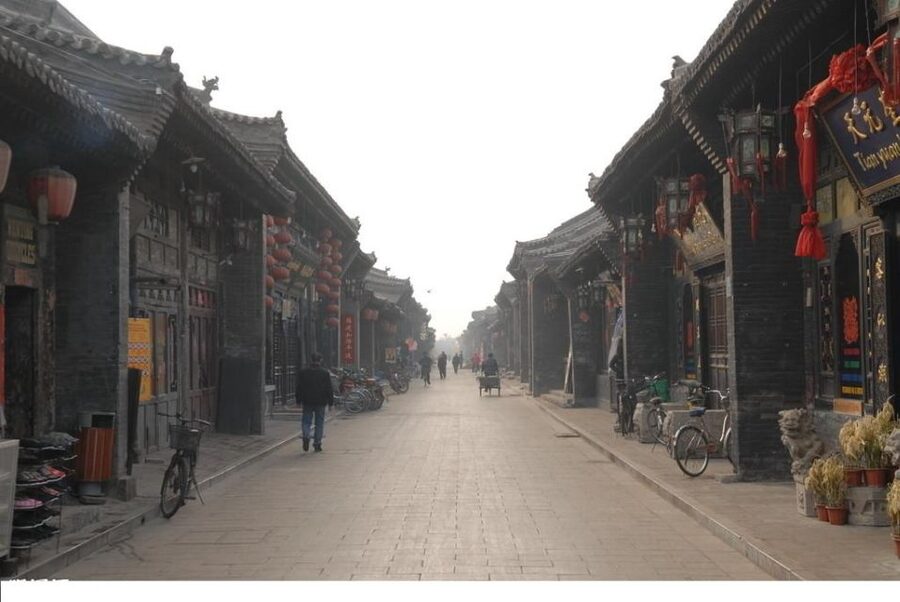
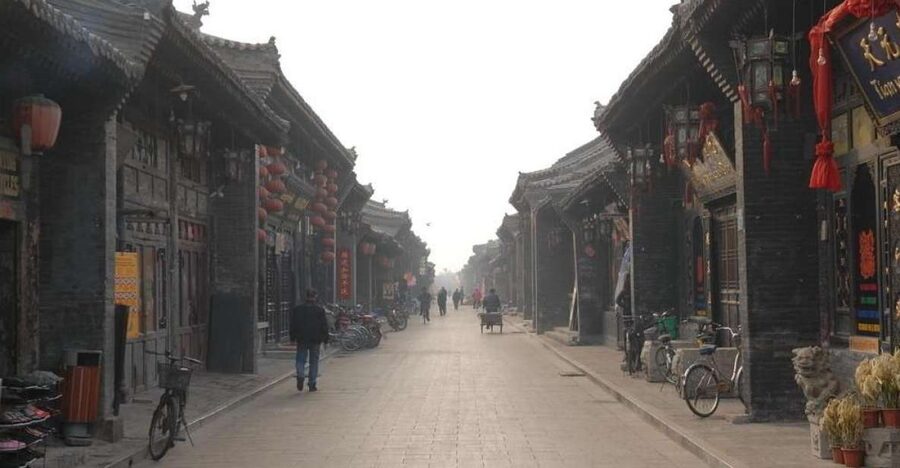
Ming and Qing Street brings you back into the everyday commercial world. Traditional shops and houses remain along the street, built in brick and stone in the architectural style of the Ming and Qing periods.
This is the part of the tour where Pingyao feels most like a living old town rather than a collection of formal sights. The narrow street, shop fronts, courtyard entrances, and traditional building forms show how commerce and domestic life sat close together.
You can compare the street with modern Chinese cities and see just how different the building style is. The old architecture is low-rise, enclosed, and shaped around courtyards. It offers a strong contrast with newer construction, though the street can also feel more commercial than the quieter lanes nearby.
Use this section to notice details. Look at the brickwork, roof lines, doorways, signs, and the relation between shop fronts and homes. Your guide can explain the symbolism and purpose of architectural features that might otherwise pass unnoticed.
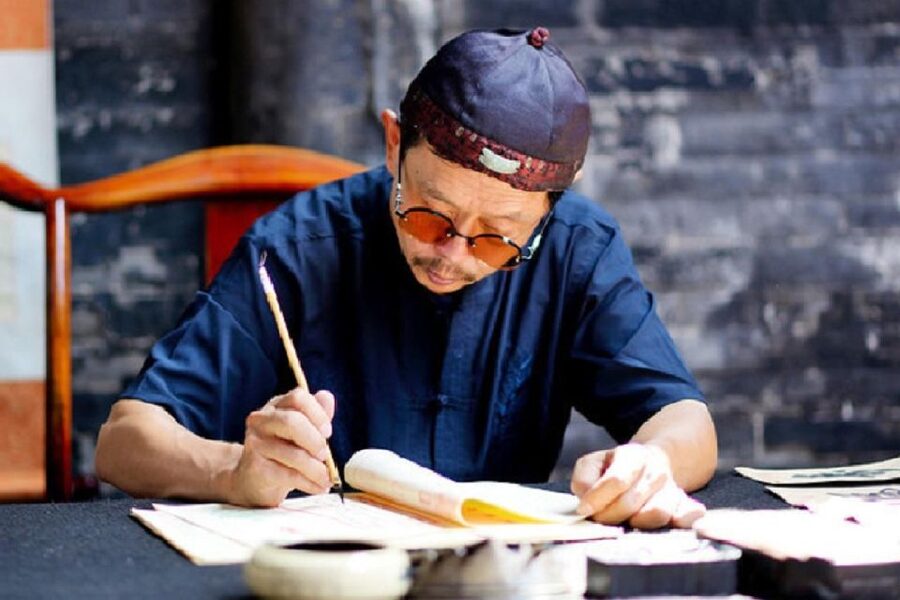
This is also a good place to ask about ordinary life. The most useful part of the tour is not only learning when a building was built. It is hearing how people worked, lived, studied, traveled, and managed family life in the old city.
The Confucian Temple and the scholar’s route
The Pingyao Confucian Temple offers a different mood from the bank and government compound. Its layout reflects the importance of Confucian learning and the imperial examination system.
If you want to understand what the temple meant to old Chinese intellectual life, follow the route associated with the top scholars of the annual imperial examinations, known as Zhuangyuan. The path connects the setting to ambition, education, status, and public service.
The temple is valuable because it shows that Pingyao’s identity was not only commercial. Trade mattered, but so did learning and the social system that trained officials. The carefully arranged spaces give you a sense of how education and achievement were honored.
The stop can be especially rewarding if you ask your guide to explain the symbolism in the layout. Architecture here carries ideas about order, respect, learning, and rank. A quick walk through may look attractive, but the meaning becomes clearer when someone explains what you are seeing.
After the larger compounds and the city wall, the temple also offers a quieter change of pace. It fits naturally into a full day because it adds an intellectual and cultural side to Pingyao’s story.
Courtyards, lanes, and ordinary life
Between the major sights, you walk through narrow streets lined with courtyard houses and small shops. These stretches are not filler. They help connect the grand sites to the people who once used them.
Pingyao’s courtyards show how homes were arranged around enclosed spaces. The narrow lanes reveal how closely daily life was tied to neighbors, shopkeepers, officials, temples, and local institutions. You get a fuller picture of the city by paying attention to the spaces between ticketed attractions.
This is where your guide’s local explanation can be most useful. The guides who have led this experience have described architecture, historical figures, city planning, and ordinary ways of life. One guide also helped with arrangements for local shows, which shows the practical benefit of having a local contact during your stay.
You may want time for photographs, especially along the old streets and at the wall. The private format makes that easier. Guides have also stopped for rest when needed, so you do not have to treat the day as a race through a checklist.
Lunch is not included, but the guide can help you find a restaurant. Mike, for example, took visitors to an excellent place for lunch. Since meals are separate, you should expect to pay for your own food and use lunch as a chance to ask about local dishes or adjust the day’s pace.
What the $229 price really buys
The price is $229 per group of up to six people. For one person, that is expensive. For six people, it works out to roughly $38 per person before admission, meals, and any transfer costs, which makes the private arrangement more reasonable.
The main value is not transport or included meals. Neither is part of the package. You are paying for a full day of one-to-one attention from an English-speaking guide, a planned route through the key sights, help with admission, and explanations that make the buildings easier to understand.
A small group can also save time and frustration. Pingyao has many historic sites, and choosing what matters most can be difficult if you are exploring without context. Your guide can connect the wall, bank, security company, Yamen, street, and temple into one story.
For couples, families, or friends sharing the cost, the arrangement is strongest. Solo visitors may find the price harder to justify unless having an English-speaking guide is a top priority. The tour is also useful for anyone with only one full day in Pingyao who wants to cover the central sights without planning every stop alone.
Guide quality and the private format
The available guides have included Lisa, Grace, Mike, Leo, Johanna, and Joanna. Their strengths, as reflected in the experience, include clear English, local knowledge, patience with questions, and a willingness to adjust the route.
Grace has explained architecture, symbolism, historical figures, and the people connected with Pingyao. Mike has been praised for his timing, stories about old ways of life, photo stops, rest breaks, and help choosing lunch. Lisa has combined city information with practical help for other activities.
Leo has provided a thoughtful and personalized visit, while Johanna has been patient during photo sessions and questions. Joanna has covered the main sights in clear English. Since guides can vary, you should still send your interests when booking and repeat them at the start of the day.
The private format is the real advantage here. You can ask basic questions without holding up a large group, spend longer at a place that interests you, or move on when you have had enough. That flexibility is worth more than a polished script.
Is this Pingyao tour right for you?
You should book this tour if you want a structured first look at Pingyao, prefer explanations in English, or are traveling with a small group that can share the fee. It is especially useful if you want more than photographs and need help understanding why a bank, temple, wall, and government compound mattered.
You might skip it if you enjoy wandering alone, already have strong knowledge of Pingyao, or want to control every minute of the day. You will also need to budget separately for admission, lunch, accommodation, and transfers.
For most first-time visitors with one full day, I see the value. The route covers the city’s main historic themes: defense, finance, trade, government, education, architecture, and ordinary life. Ask for your preferred interests in advance, wear comfortable shoes, and keep the day flexible enough for photos and a proper lunch.
FAQ
How long does the Pingyao walking tour last?
The activity lasts eight hours, with about six hours listed for sightseeing in Pingyao.
Where does the guide meet me?
If your hotel is inside Pingyao Ancient City, the English-speaking guide meets you in the hotel lobby. If your hotel is outside the old city, the meeting is arranged inside the old town.
Is this a private tour?
Yes. It is a private group experience for up to six people.
What languages are available?
The tour offers English and Chinese guiding. The experience information specifically describes an English-speaking guide.
Are admission tickets included?
No. Admission costs 125 RMB per adult, children pay half price, and the guide enters free. The guide helps you buy the tickets on the tour day.
Are meals and transfers included?
No. Meals, hotel accommodation, and transfers are not included. The guide can help you choose a restaurant during the day.
New reviews from China
- Shanghai To Beijing Bullet Train Ticket with Local Private Transfer★ 5.0 · 12 reviews
- Shanghai Spicy Food Tour★ 5.0 · 3 reviews
- Shanghai Uncommon Historic Sites Tour★ 5.0 · 3 reviews
- Shanghai Pudong airport transfer to Disneyland:Private with Meet & Great service★ 5.0 · 3 reviews
- Shanghai Tower Observation Deck 118 floor Tickets Pre-booking.★ 5.0 · 4 reviews
- Private Transfer: Hotel to Shanghai Wusongkou Cruise Terminal (Baoshan Port)★ 3.5 · 6 reviews
- Shanghai Pudong International Airport (PVG) to Shanghai Hotel★ 5.0 · 4 reviews
- Pudong Airport to Hangzhou: Private with Meet and Greet Service★ 4.5 · 4 reviews
Walking Tours, compared.

Beijing Hutong Walking Food and Beer Tour at Hidden Restaurants
Read our review →
Private Beijing Walking Tour of the Forbidden City with 7 Options
Read our review →
Dark Side of Hong Kong – Kowloon Caged Homes Walking Tour
Read our review →
Forbidden City Private Walking Tour with Optional Sights
Read our review →
Shanghai City Guided Walking Tour | China’s 1st and Best Rated
Read our review →
Introduction to Hong Kong: Central Tip Based Walking Tour
Read our review →
Browse the lists this tour appears in