
Reviewed · LAMA TEMPLE TOURS
Beijing Lama Temple Entrance Ticket with Optional Guided Service
Beijing’s Lama Temple is not a quiet museum piece. It is a working Tibetan Buddhist temple where people pray, light incense, and move through halls that once belonged to the Qing imperial family. I like the incense ritual and the chance to see the enormous sandalwood Maitreya Buddha, details that make this more than a quick sightseeing stop. I also like the choice between a low-cost ticket and a private English-speaking guide.
The main drawback is ticket handling. Several people received working QR codes, but others did not receive a usable code and had to pay again at the temple. You need to watch your email, download the ticket before arrival, and contact the operator promptly if anything is missing.
Key points to know before you go
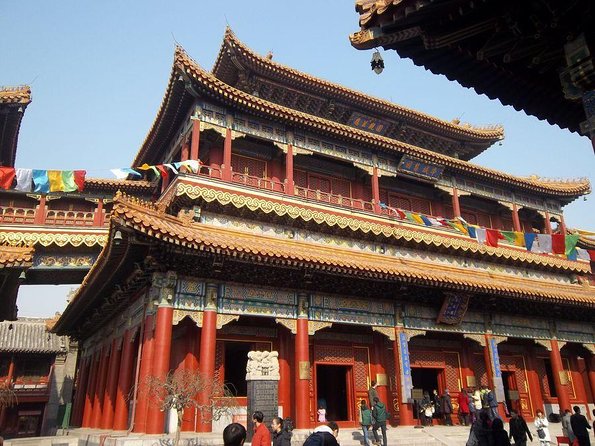
- A former royal palace: Yonghegong was converted into a Tibetan Buddhist temple under the Qianlong emperor of the Qing Dynasty.
- A living place of worship: Take the incense offered at the entrance and watch the prayer ritual rather than treating the site as only a museum.
- Two ways to visit: Choose admission only, or upgrade to a private English-speaking guide for your group.
- Guides with useful temple knowledge: Mina, Mike, Kevin, and Jack are named in the tour information and have led visits in clear English.
- QR code timing matters: Your ticket is expected about five days before the visit, not at the instant you book.
- Value depends on timing: The local admission price is reported as 25 yuan, so the prepaid ticket is most useful when it saves time during busy periods.
Why Yonghegong is more than another Beijing temple
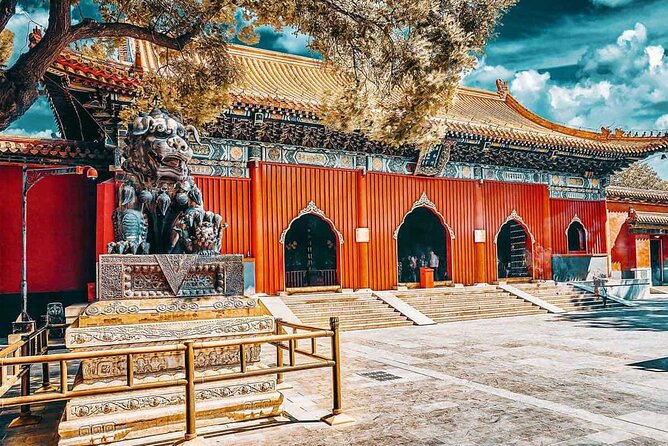
The Lama Temple, also called Yonghegong, sits in northeastern Beijing. Its name is often translated as the Palace of Peace and Harmony, an appropriate title for a site that moved from imperial life into Tibetan Buddhist practice.
The complex began as a royal residence and later became one of China’s most important Tibetan Buddhist temples. That change gives the visit its special character. You are not simply walking past old buildings. You are moving through former Qing court grounds that still serve a religious purpose.
I find that combination especially useful for understanding Beijing. The temple connects imperial power, Tibetan Buddhism, Chinese architecture, and daily prayer in one compact visit. If you only have time for photographs, you may miss the point. Pause in the halls, notice the worshippers, and take in the incense ritual.
The temple is also near public transportation, which makes it practical to fit into a day of sightseeing. It is close to the Confucius Temple and the popular Chengxian Street, so you can pair the visit with nearby cultural sights without arranging a separate full-day excursion.
Other temples to walk round in Beijing:
- Temple Heaven, Lama Temple, Summer Palace & Peking Duck Bus Tour
★ 5.0 · 377 reviews - Temple Heaven, Summer Palace, Lama Temple, Hutong Bus Tour
★ 4.7 · 319 reviews - Temple of Heaven, Summer Palace, Lama Temple, Hutong Tours
★ 5.0 · 311 reviews
Choosing between a ticket and a private guide
The basic option gives you entrance to the temple. That is the right choice if you have already read about Yonghegong, prefer to move at your own pace, or mainly want a straightforward way through the entrance process.
The guided option adds an English-speaking guide for your private group. Names connected with guided visits include Mina, Mike, Kevin, and Jack. Mina is described as explaining the purpose of the buildings, religious details, and the large sandalwood Maitreya statue. Mike focused on Tibetan Buddhism and the temple itself, while Kevin helped with explanations and general organization. Jack is noted for clear English and thorough explanations.
A guide can make a real difference here because the buildings are not self-explanatory. Without context, you may see a sequence of ornate halls, statues, incense burners, and worshippers. With a guide, you can better understand how the former palace became a religious center and why particular halls and objects matter.
The guided option is still not a long, scheduled sightseeing circuit with several city stops. The advertised itinerary has one stop, Lama Temple, and the duration is listed as about one day. Read that as a flexible temple visit rather than a full day of continuous guiding. One person found the time inside shorter than expected because the temple closed early, so confirm the planned timing if your schedule is tight.
Entering through the Yonghegong complex
Your visit begins at Lama Temple, or Yonghegong. The entrance ticket is included, and the admission-only version is designed to let you handle the visit independently.
The site can become busy. At some times, the entry queue moves quickly, while at peak periods advance booking may save a longer wait at the ticket counter. This is the strongest practical reason to prepay. If you arrive when the temple is quiet, the advantage may be smaller because the local admission price is reported as 25 yuan and there may be little or no line.
That price comparison deserves attention. A $7 ticket is not automatically a bargain if the local entrance is easy to buy and costs less. You are paying for advance arrangement and, potentially, convenience. The value improves during crowded periods, when avoiding the ticket purchase line matters more than saving a few yuan.
There is also a basic technical risk. The ticket is sent around five days before your travel date, and several successful visits depended on a working QR code. Download the code before leaving your hotel. Do not rely only on an app page or an unstable internet connection at the gate.
The incense ritual and active worship
One of the most memorable parts of Yonghegong is the incense ritual. Incense sticks are offered, and you will see people carrying them into the temple grounds for prayer. The practice gives the visit a human scale that old architecture alone cannot provide.
You should approach this respectfully. Watch how people pray, keep a little space around worshippers, and avoid treating the ritual as a staged performance. The temple is both a historic attraction and an active religious site.
This is where the optional guide can help. A good guide can explain what you are seeing without turning the visit into a dry lecture. The better guided experiences described here combine building history with religious details, which is the useful mix for a first visit.
If you choose the ticket-only option, you can still take part in the atmosphere at your own pace. The temple offers enough visual interest to reward independent visitors, but you will need to supply your own background information.
A few more days out in Beijing worth the ticket
- Beijing: Forbidden City Tour(Group/Private)-Tickets Included
★ 4.8 · 7,974 reviews - 4-Hour Small Group Tour to Forbidden City with Entry Tickets
★ 5.0 · 1,863 reviews - Beijing: Tiananmen Square Registration Service(Ticket)
★ 4.5 · 1,704 reviews - Beijing: The Temple of Heaven or Summer Palace Entry Ticket
★ 4.6 · 1,286 reviews
The halls, statues, and the 18-meter Maitreya
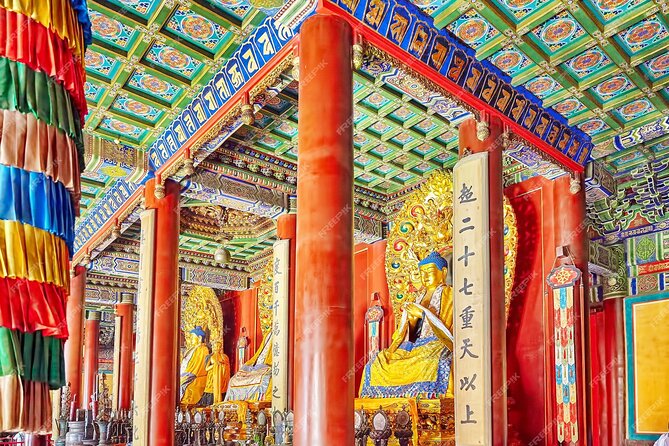
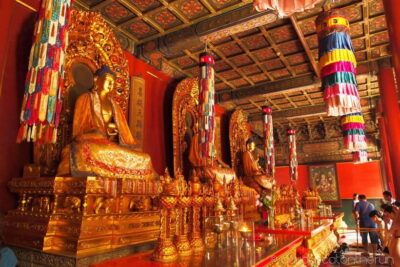
The complex contains several temple buildings, each with its own visual and religious focus. The most frequently highlighted object is the giant sandalwood Maitreya Buddha statue, reported as about 18 meters high. It is carved from a single piece of sandalwood and is housed in the final hall.
This is the sight to save your attention for. The size is striking, but the setting matters just as much. You are seeing a major religious image in a functioning temple, not an isolated object in a display case.
A guide can also point out smaller details that are easy to pass. Mina’s explanations reportedly included the use of individual buildings, religious practices, and subtle features of the temple treasures. That kind of help is valuable if you want more than a series of attractive photographs.
The visit has a natural progression through the complex, with ornate halls and courtyards leading toward the larger Buddha image. You should allow time to stop rather than rush from gate to gate. The exact amount of time available can change, especially if the temple closes early or operating conditions shift.
What the guided visit adds
The private format means only your own group participates. That can make questions easier and avoids being tied to a large shared group. It also gives the guide a chance to adjust explanations to your interests, although the available information does not promise a custom route or a fixed length.
The strongest reason to choose a guide is interpretation. Tibetan Buddhist symbols and temple functions are not always obvious, even if you have visited other Chinese temples. Clear English explanations can turn a beautiful but confusing visit into a more understandable one.
The named guides receive consistently favorable attention in the supplied material. Mina is associated with detailed explanations, Mike with strong knowledge of Tibetan Buddhism, Kevin with helpful assistance, and Jack with clear English and thorough commentary. You cannot necessarily request a particular guide, so treat those names as examples of the type of service available rather than a guarantee.
The private format also comes with a limitation. If you prefer solitude, a guide may feel unnecessary. The temple is manageable on your own, especially if your main goals are incense, architecture, and the large Maitreya statue.
Ticket delivery, weather, and customer support
The biggest weakness is not the temple itself. It is the possibility of a ticket communication problem.
Most successful visits described here involved QR codes arriving on time and working at the entrance. Other people received a booking confirmation without a usable ticket, could not download the file, or found that the code shown at the gate was not accepted. Some then bought a second ticket in person.
The operator says tickets are sent by email about five or six days before the date and provides contact details for help. That means you should check your inbox and spam folder several days ahead. If the code is missing, contact the operator by phone or email before going to the temple. Do not wait until you are standing at the entrance.
Messaging through WhatsApp may not be reliable in China, according to the operator’s response. Use the contact method supplied with your booking, and keep proof of any second ticket purchase if you need to request a refund.
Weather has also caused cancellations. Beijing attractions closed for two days during one April weather event, leaving some people without clear notice until they reached the temple. The stated cancellation terms allow a full refund if you cancel at least 24 hours before the start time. For an operator cancellation caused by closure, request the refund through the booking platform and keep the cancellation message.
Is $7 good value?
At $7 per person, the ticket is reasonably priced for a major Beijing cultural stop, but the value is not automatic. Local admission has been reported as 25 yuan, and some people found no meaningful line at the temple. If you are already nearby and the ticket counter is open, buying in person may cost less.
Advance purchase makes more sense when you are visiting in a busy season, have limited time, or want the entrance arranged before you arrive. It can also be useful if you are uncomfortable handling a Chinese ticket counter.
The guided upgrade is easier to justify if you care about context. The temple’s importance is not only visual, and the religious details can pass unnoticed without explanation. If you are traveling with family or friends who enjoy history and culture, a private guide may offer better value than paying for several separate audio or museum services.
Group discounts are listed, so larger parties should check the price before booking. The activity is private when the guided option is selected, but the supplied information does not give a specific group size or discount amount.
Who should book this visit?
I would consider this experience for a first visit to Beijing, especially if you want a site that connects imperial history with active religion. It also suits people who enjoy observing local customs, since the incense ritual is a central part of the visit.
Choose the guide if:
- You want clear English explanations of Tibetan Buddhism.
- You would like help understanding the purpose of the halls and statues.
- You are traveling with a private group and prefer to ask questions.
- You want to make the large Maitreya Buddha and other temple treasures more meaningful.
Choose admission only if:
- You prefer setting your own pace.
- You already know something about the temple.
- You mainly want architecture, incense, and photographs.
- You are comfortable checking your own route and timing.
The visit is near public transportation, and most people can participate. Still, plan around the temple’s opening conditions rather than assuming you will have unlimited time inside.
My booking advice
Book this tour if saving time at the ticket counter matters to you or if you want an English-speaking guide to explain the religious setting. The temple itself is worthwhile, and the incense ritual plus the huge sandalwood Maitreya Buddha give the stop real character.
I would be more cautious about the ticket-only option during a quiet period. If the local admission is 25 yuan and there is no line, the prepaid service may not save much money. In every case, verify the QR code several days before the visit. That one step separates a smooth entry from an unnecessary second ticket purchase.
FAQ
Where is the Lama Temple located?
The Lama Temple, also called Yonghegong, is in northeastern Beijing and is near public transportation.
What is included in the basic booking?
The basic booking includes the entrance ticket to Lama Temple.
Is a guide included with every ticket?
No. An English-speaking guide is included only when you select the guided option.
Is the guided visit private?
Yes. The activity is described as private, with only your group participating.
When should I receive the QR ticket?
The ticket is expected about five days before the travel date. The operator also refers to sending QR codes five to six days ahead.
What should I do if I cannot find the QR code?
Check your email and spam folder, then contact the operator using the supplied phone number or email address before visiting the temple.
Can I visit the temple without a guide?
Yes. You can select the entrance ticket without the guided service and explore the temple independently.
Is public transportation available near the temple?
Yes. The temple is described as being near public transportation.
What is the cancellation policy?
You can cancel for a full refund at least 24 hours before the experience start time. Cancellations or changes made less than 24 hours ahead are not accepted for a refund.
New reviews from Beijing
- Private Transfer to Mutianyu Great Wall with professional driver★ 5.0 · 19 reviews
- One day tour to downtown Tianjin from Beijing by high speed train★ 5.0 · 3 reviews
- camp on the Great Wall overnight with sunrise and sunset on the wall★ 5.0 · 11 reviews
- ZANBUS: Trip to the Jinshanling Great Wall Departing at 7:30 AM★ 5.0 · 5 reviews
- BusDa:Ancient Great Wall &Badaling Great Wall Full-day Bus Tour★ 4.5 · 6 reviews
- Yuxiandu Chinese Royal Cuisine Museum with Show and Royal Banquet★ 5.0 · 4 reviews
- Wild Great Wall Hikes★ 5.0 · 10 reviews
- Wild Great Wall Huanghuacheng Half Day Tour★ 5.0 · 15 reviews
Lama Temple Tours, compared.
Temple Heaven, Lama Temple, Summer Palace & Peking Duck Bus Tour
Read our review →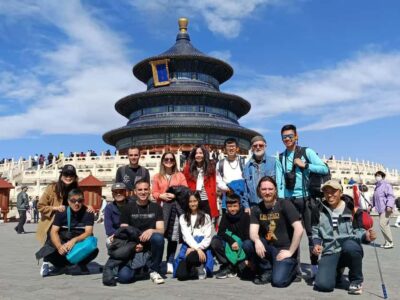
Temple Heaven, Summer Palace, Lama Temple, Hutong Bus Tour
Read our review →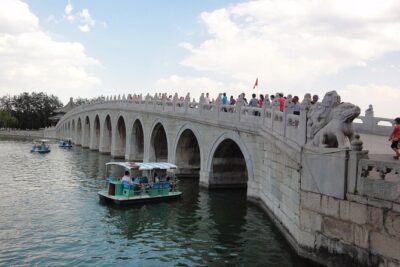
Temple of Heaven, Summer Palace, Lama Temple, Hutong Tours
Read our review →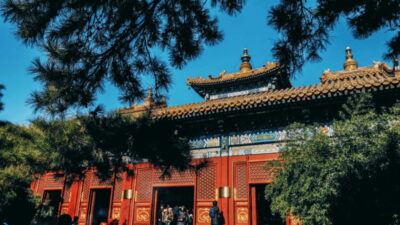

Beijing Historical Tour II including Summer Palace, Lama Temple & Panda Garden
Read our review →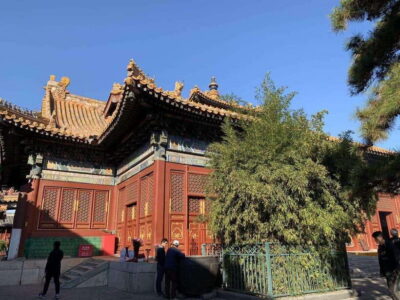
Beijing Lama temple ticket; #1 efficacious; limited Discount
Read our review →
Panda House, Temple of Heaven, Lama Temple, Summer Palace & Lunch
Read our review →Browse the lists this tour appears in