Reviewed · TOURS IN BEIJING
Beijing:Drum and Bell Towers Entry Ticket- Cultural Treasure
Beijing’s Drum and Bell Towers offer a fine look at how the old capital kept time before clocks ruled daily life. The 63-ton Yongle-era bell and the Drum Tower’s former set of 25 drums give these buildings real weight, both physically and historically.
I like the pre-booked entry, especially during busy periods such as China’s Golden Week. I also like the useful English PDF guide, which adds background on the towers, nearby hutongs, and local restaurants. The main drawback is value: at $13 per person, you may pay more than the on-site ticket price.
Key points
- The 63-ton bell: See the massive Ming Dynasty bell known as China’s King of Ancient Bells.
- Two historic towers: Your ticket covers both the Drum Tower and the Bell Tower.
- Ancient timekeeping: Learn how a dusk drum and morning bell marked the rhythm of Beijing.
- English visitor material: Use a textual and visual guide instead of relying on a live guide.
- Hutongs next door: Add a walk through Beijing’s old residential lanes after your visit.
- Steep stairways: The climb is long and sharply angled, so this visit is not suited to everyone.
Why These Two Towers Matter in Beijing

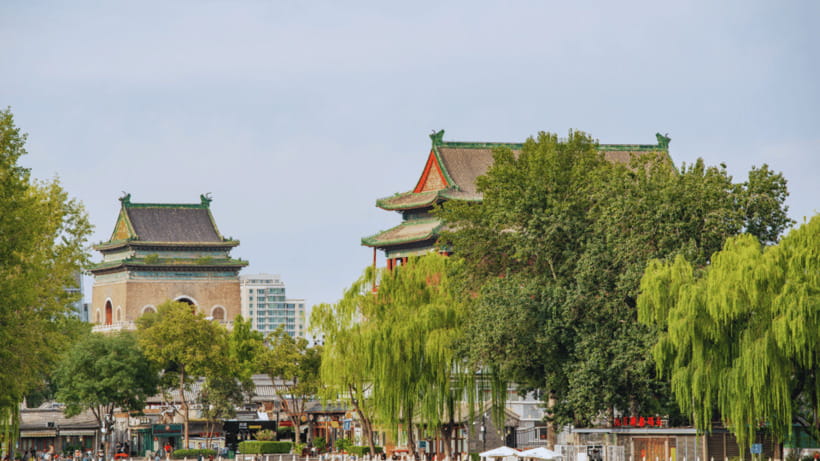
The Drum and Bell Towers sit at the northern end of Beijing’s central axis. They were first built during the Yuan Dynasty, from 1206 to 1368, and continued their timekeeping role through the Ming and Qing dynasties.
That role may sound simple today, but it shaped the daily life of the old capital. Before modern clocks, the towers announced the hours to the city. The traditional pattern was a dusk drum and a morning bell. In a city organized around imperial schedules, those sounds carried practical power.
The buildings also help you picture old Beijing as a planned capital. They are not simply two attractive historic structures placed side by side. The Bell Tower sits slightly north of the Drum Tower, creating a distinctive layout within the city’s central axis.
Both towers are protected at the national level, and the complex covers 12,597 square meters. Those figures matter less once you are on site than the scale of the buildings themselves. From ground level, you get a clear sense that these were working civic structures, not just decorative monuments.
A few more days out in Beijing worth the ticket
- Beijing: Forbidden City Tour(Group/Private)-Tickets Included
★ 4.8 · 7,974 reviews - 4-Hour Small Group Tour to Forbidden City with Entry Tickets
★ 5.0 · 1,863 reviews - Beijing: Tiananmen Square Registration Service(Ticket)
★ 4.5 · 1,704 reviews
Starting With the Drum Tower

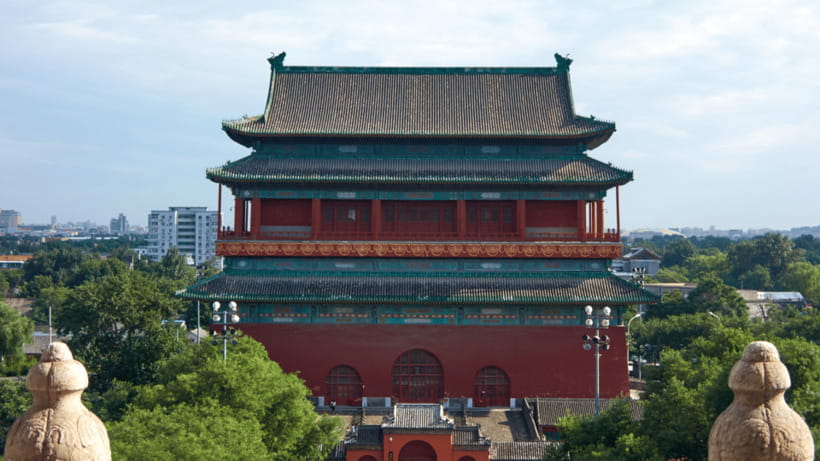
Most visitors will want to allow time for both buildings rather than treating one as a quick photo stop. The Drum Tower is the larger part of the visit in terms of its visual impact, with a major climb before you reach the upper level.
The tower once held 25 drums. Their purpose was not musical entertainment in the modern sense. They helped announce the passing of time across Beijing. That gives the interior a practical story: this was a citywide communication point.
As you move through the building, look beyond the drums themselves. The value is in seeing how a tall, traditional Chinese tower was arranged for public timekeeping. The upper level also gives you a better view of the surrounding area, including the older hutong district nearby.
The stairs deserve serious attention. They are steep, fairly long, and can feel demanding even for people who normally manage historic sites without trouble. Take your time, use the available handrails, and avoid treating the climb as a race.
If you have reduced mobility, this may not be a suitable attraction. The difficulty is not a minor inconvenience limited to one small staircase. Reaching the main areas requires a substantial climb.
The Bell Tower and China’s 63-Ton Bell
The Bell Tower sits slightly north of the Drum Tower. Its centerpiece is the bell cast during the Yongle era of the Ming Dynasty, from 1403 to 1424.
The bell weighs 63 tons and is known as the King of Ancient Bells in China. Even without a live guide, that fact gives the visit a strong focal point. You can connect the object in front of you with the tower’s former job: sending the morning signal across the capital.
The Bell Tower is also a reminder that old timekeeping depended on sound traveling over distance. The bell had to be large, powerful, and carefully placed. This is one reason the structure feels more than symbolic. It was part of Beijing’s working system.
The arrangement of the two towers adds another layer. The Drum Tower and Bell Tower are closely related, but they are not duplicates. Seeing both lets you compare their roles, proportions, and position within the historic city plan.
The stairs here can also be steep. Plan your energy across both towers, especially if you are visiting in warm weather or have already spent the morning walking around central Beijing.
What the Two-Hour Visit Feels Like

The suggested duration is two hours, which gives you enough time to enter both towers, read the guide, inspect the historic features, and pause for photos without turning the visit into a full-day commitment.
You can use the time in several ways:
- Spend more time with the drums and bell if old engineering and city history interest you.
- Read the English material as you go, rather than trying to absorb every detail before entering.
- Pause around the complex to understand the relationship between the two towers.
- Leave time for a short walk in the surrounding hutongs.
The visit does not include a live guide or an audio guide. That is important when you decide how much structure you want. You will receive an English textual and visual guide, so you are not left without context, but the experience remains self-guided.
I see this as a strength for independent visitors who like to set their own pace. It is less ideal if you want a person explaining each architectural detail in real time.
Same city, a completely different day:
- From Beijing: Mutianyu Great Wall Tours with Options
★ 4.9 · 9,216 reviews - Beijing: T-Square & Forbidden City Group or Private Tour
★ 4.8 · 4,446 reviews - All-Inclusive Tour: Tiananmen Square, Forbidden City, Great Wall
★ 5.0 · 2,873 reviews - MuBus: Mutianyu Great Wall ENG/ESP/RUS Guided Bus Tour
★ 5.0 · 2,361 reviews
The English Guide and Nearby Hutongs
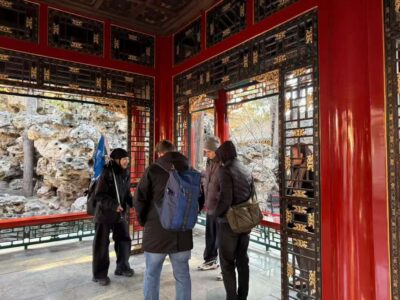
The English PDF guide is one of the more useful parts of the booking. It covers the Bell and Drum Towers and also includes information about the surrounding hutongs and suggestions for nearby restaurants.
That extra material can change how you use the visit. You could arrive, see the towers, and leave with only a few photographs. Or you can use the guide to connect the monuments with the older residential lanes around them.
The hutongs are especially worth noting because they sit right next to the towers. A visit here does not need to end at the entrance gate. After seeing the formal historic buildings, you can walk into a more everyday part of Beijing and look for a nearby meal.
The available information does not promise a guided hutong walk, restaurant reservation, or meal. You are simply given useful written suggestions. That distinction matters. The value comes from helping you notice what is nearby, not from adding another hosted activity.
Booking, Tickets, and Timing
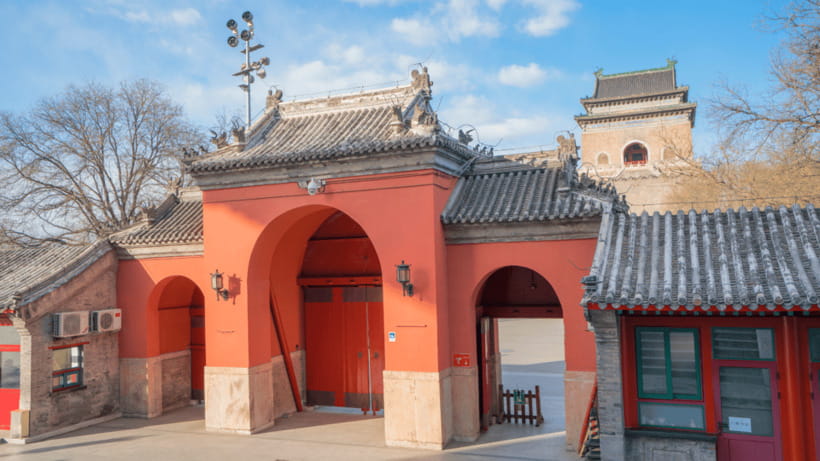
The booking process requires your passport name, passport number, and date of birth. Hua Hua Explore China reserves the tickets three days before your visit.
Once the reservation succeeds, the electronic tickets are sent by email or WhatsApp. You then use those tickets to enter the Bell Tower and Drum Tower directly.
This arrangement is helpful if you prefer to have admission settled before reaching the site. It can also be useful during major holiday periods, when Beijing attractions may be crowded. One visitor specifically found the service efficient during Golden Week, receiving the QR codes and English brochure in advance.
Still, pre-booking has a cost. The listed price is $13 per person, and you should compare that with the expected on-site admission price before you buy. One Italian visitor felt the package charged too much compared with purchasing locally. Since the available information does not state the exact walk-up price, I would treat the $13 as a convenience fee as much as an admission price.
The booking also offers free cancellation up to 24 hours before the visit and a reserve-now, pay-later option. Those terms give you some flexibility if your Beijing schedule is still moving around.
Bring your passport or ID card. You should also make sure the name and document details supplied during booking match the identification you carry.
Is Skipping the Ticket Line Worth the Price?

The biggest practical reason to book is direct entry with electronic tickets. You are paying for advance organization, not for a private tour or personal interpretation.
That can be worthwhile if:
- You are visiting during a busy period.
- You dislike handling ticket purchases on arrival.
- You want an English guide in hand.
- You have limited time and prefer a ready-to-use booking.
- You are comfortable paying extra for convenience.
It may be less worthwhile if:
- You are watching every yuan.
- You are comfortable buying admission on site.
- You already have reliable information about the towers.
- You want a live guide or audio commentary.
The experience itself is not luxury priced, but the $13 fee needs to be judged against local ticket costs and your tolerance for queues. I would not buy it blindly. I would first check whether direct entry and the English material solve a real problem for your trip.
Who Will Enjoy This Visit Most?
I recommend the towers to visitors who enjoy historic city planning, traditional Chinese architecture, and small sites with a clear civic purpose. You do not need to be an expert in Chinese history to appreciate them. The basic story is easy to grasp: one tower used drums, the other used a huge bell, and both helped regulate life in the capital.
This is also a good choice if you are already exploring northern central Beijing. The towers provide a fixed historical stop, while the nearby hutongs give you a chance to continue on foot.
Families with older children may find the visit interesting, particularly if you explain the towers as an ancient public clock. The climb, not the subject matter, is the main concern.
The site is a poorer fit for anyone with limited mobility. The stairways are steep and lengthy, and there is no information here about an accessible alternative route. If stairs are difficult for you, consider the towers from outside and spend your time in the surrounding area instead.
Photography fans should find plenty to notice in the structure and layout, but this is not presented as a special photography tour. The experience is best for people who want to look closely, read a little, and connect the buildings with Beijing’s older neighborhoods.
What I Like, and What I Would Change

I like the simple focus. You get two important buildings, one clear historical theme, and enough time to see both without giving up an entire day.
I also like the connection to the hutongs. The English guide reportedly includes local restaurant suggestions, which makes the visit more useful than a quick stop at two isolated monuments. You can turn the outing into a short neighborhood exploration.
The organization is another plus. Receiving tickets and QR codes in advance is reassuring, especially when you are visiting during a holiday rush. The reserve-now, pay-later option and 24-hour cancellation policy add flexibility.
The weak point is the lack of personal explanation. A live guide could help you understand the architecture, the role of the drums, and the bell’s construction in a more vivid way. The written guide helps, but you must do the reading yourself.
The other concern is price. At $13 per person, the booking may cost more than buying directly at the towers. You are deciding how much convenience is worth. For a first-time visitor during a busy season, the answer may be yes. For a budget-minded visitor on a quiet weekday, perhaps not.
Should You Book the Drum and Bell Towers?
Book this experience if you want both towers arranged in advance, plan to visit during a busy period, and value an English guide that points you toward the nearby hutongs. The QR-code entry and flexible booking terms make the practical side easy.
Skip it, or compare local admission first, if your main goal is the lowest possible price. Also skip it if steep stairs are a serious issue, since the climb is a central part of the visit.
For most independent visitors, I see this as a worthwhile two-hour cultural stop, provided you understand what you are buying. You are not getting a live guide, transport, or an audio tour. You are getting entry to two important Beijing towers, advance ticket handling, and written help for making more of the neighborhood around them.
FAQ
How long does the visit take?
The stated duration is two hours. That allows time for both towers and the included written guide.
What does the ticket include?
It includes admission to the Bell Tower, admission to the Drum Tower, and an English textual and visual guide.
Is a live guide included?
No. The experience does not include a live tour guide.
Is an audio guide included?
No. An audio guide is not included.
How do I enter the towers?
After a successful reservation, you receive electronic tickets by email or WhatsApp. You can use those tickets to enter the Bell Tower and Drum Tower directly.
What identification should I bring?
Bring your passport or ID card. Your passport name, passport number, and date of birth are required for the reservation.
When are the tickets reserved?
The tickets are reserved three days before your visit.
Is the site suitable for people with reduced mobility?
The stairways are steep and fairly long, so the visit is not suitable for everyone with reduced mobility.
Can I cancel the booking?
Yes. You can cancel up to 24 hours in advance for a full refund.
New reviews from Beijing
- Mutianyu Wall, Summer Palace & Old Summer Palace Day Tour★ 4.8 · 34 reviews
- Night Market Haggling Adventure with an English Guide!★ 4.8 · 7 reviews
- BusDa-Mutianyu Great Wall&Forbidden City Full-day Coach Tour★ 4.9 · 11 reviews
- Mutianyu Great Wall Ticket with Roundtrip Cable Car★ 5.0 · 20 reviews
- Mutianyu Great Wall Bus Trip+Ticket 7/8/9/10/13/13:30/15:30★ 4.7 · 24 reviews
- Mutianyu Great Wall Entry Ticket Chairlift Up Toboggan Slide★ 4.9 · 8 reviews
- Mutianyu Great Wall 5-KM Guided Hike with Uphill Cable Car★ 4.8 · 16 reviews
- Mutianyu Great Wall Admission Ticket★ 3.6 · 7 reviews
Tours in Beijing, compared.


Forbidden City Tour(Group/Private)-Tickets Included
Read our review →
T-Square & Forbidden City Group or Private Tour
Read our review →
All-Inclusive Tour: Tiananmen Square, Forbidden City, Great Wall
Read our review →
MuBus: Mutianyu Great Wall ENG/ESP/RUS Guided Bus Tour
Read our review →
4-Hour Small Group Tour to Forbidden City with Entry Tickets
Read our review →
Beijing Full Day Tours: Tiananmen Sq, Forbidden City, Great Wall
Read our review →