Reviewed · TOURS IN BEIJING
Beijing: Confucius Temple and the Impercial College E-ticket
The most striking feature here is the Imperial Examination display. More than 51,000 successful candidates have their names, birthplaces, and ranks carved into stone tablets at the Confucius Temple. It is an unusually direct look at how education and government worked in imperial China.
I like the easy entry: you need your QR code and original passport, not a printed voucher. I also like the paired layout, with the Confucius Temple on the left and the Imperial College on the right, linked by a shared historical purpose. The main drawback is simple: this is an admission ticket, not a guided tour, so you will need to read the exhibits or arrange an audio guide yourself.
Key points
- 51,624 successful candidates recorded in stone: The tablets offer a rare, physical record of China’s imperial examination system.
- Two historic institutions in one visit: See the Confucius Temple and the former national school, arranged as temple on the left and college on the right.
- Yuan Dynasty foundations: The complex dates from the 1300s and includes more than 700 years of surviving history.
- QR code plus passport entry: Bring your original passport and electronic ticket for admission.
- Three Confucius Temple exhibitions: Displays cover the restored Dacheng Hall, Confucius, and the temple’s own history.
- Good value at $7: The ticket covers both attractions for one day, though interpretation is mostly up to you.
Why this Beijing visit is worth your time
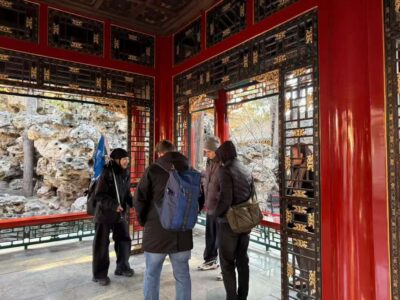
Beijing has no shortage of grand imperial sights. The Confucius Temple and Imperial College offer something different. Instead of royal power, the focus is on learning, ritual, government service, and the people who passed China’s demanding civil examinations.
That makes this a particularly useful stop if you want to understand how educated officials were selected during the Yuan, Ming, and Qing dynasties. The buildings matter, but the stone tablets may be the most memorable part. They turn an abstract subject, the imperial examination system, into a long list of real names and places.
At $7 per person, the ticket is inexpensive for a full day of admission to two connected historic sites. You are paying for access, not a lecture or a planned route. I see that as good value for independent visitors who enjoy setting their own pace. If you prefer a guide to explain every hall and symbol, budget for an audio guide or arrange separate help.
The experience has a rating of 4.4 out of 5 from 92 ratings, and two practical details come through clearly: entry is straightforward with the electronic ticket, and an audio guide may be available at the entrance. Those details make the visit easier, but you should still bring your passport and allow time to read the displays.
A few more days out in Beijing worth the ticket
- Beijing: Forbidden City Tour(Group/Private)-Tickets Included
★ 4.8 · 7,974 reviews - 4-Hour Small Group Tour to Forbidden City with Entry Tickets
★ 5.0 · 1,863 reviews - Beijing: Tiananmen Square Registration Service(Ticket)
★ 4.5 · 1,704 reviews
Entering the Confucius Temple with your passport
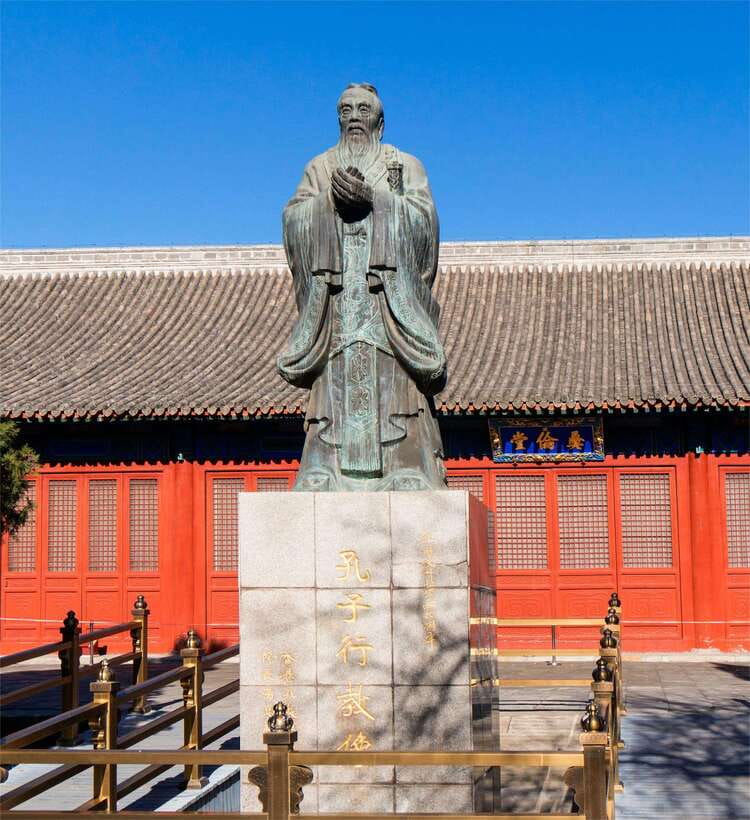
The electronic ticket is designed for direct entry. At the attraction, show the QR code and your original passport. Do not rely only on a photo or a copy, since the entry instructions specifically require the original passport.
The ticket is valid for one day. The stated duration is one day rather than a fixed guided schedule, so you have room to decide how long to spend in each courtyard. Starting times depend on availability at booking, but the ticket itself is not described as a timed tour with a guide.
The site is wheelchair accessible, which is useful for visitors who need step-free access or prefer a more manageable cultural visit. Still, the complex contains several historic courtyards and traditional buildings. The accessibility information confirms that the attraction is accessible, but it does not provide a detailed route map, so you may want to ask staff about the easiest path when you arrive.
The Confucius Temple’s three courtyards
Beijing Confucius Temple was built in 1306, during the Yuan Dynasty. It served as a place for ceremonies honoring Confucius during the Yuan, Ming, and Qing periods.
The temple covers more than 22,000 square meters, with about 7,400 square meters of building space. Its three courtyards follow a central north-south axis. As you move through the complex, the sequence of gates and halls gives the visit a clear sense of ceremony.
The main route includes:
- Teacher Gate
- Dacheng Gate
- Dacheng Hall
- Chong Sheng Temple
This arrangement is not just a collection of old buildings. The progression from gate to hall reflects the importance given to Confucius and the formal nature of the ceremonies held here. Take your time with the courtyards rather than rushing straight to the largest hall. The layout is part of the lesson.
Dacheng Hall is the central focus of the temple. One of the exhibitions presents a restored version of the hall, giving you a closer look at its role and appearance. The name may be unfamiliar, but the building helps explain how Confucian respect was expressed through architecture, placement, and ritual.
The temple’s architecture is one of the strongest reasons to visit. You are not seeing a modern museum built around a few objects. You are walking through an old ceremonial setting where the buildings, stonework, gates, and exhibitions belong to the same story.
The examination tablets and China’s education system
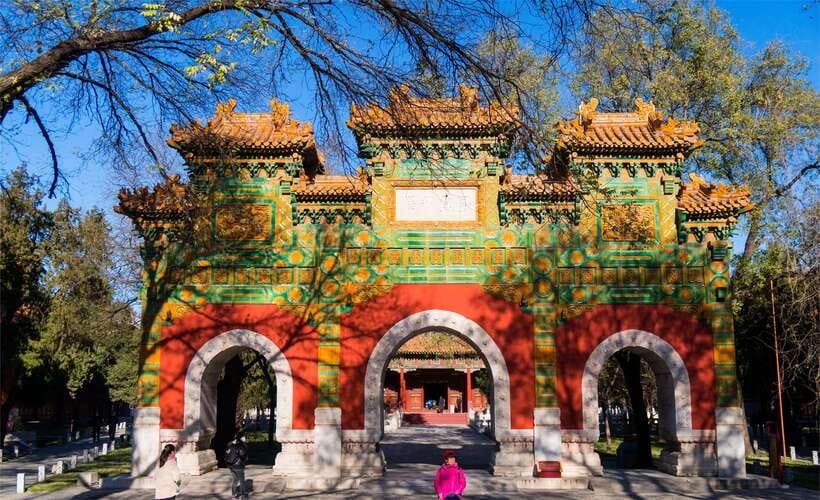
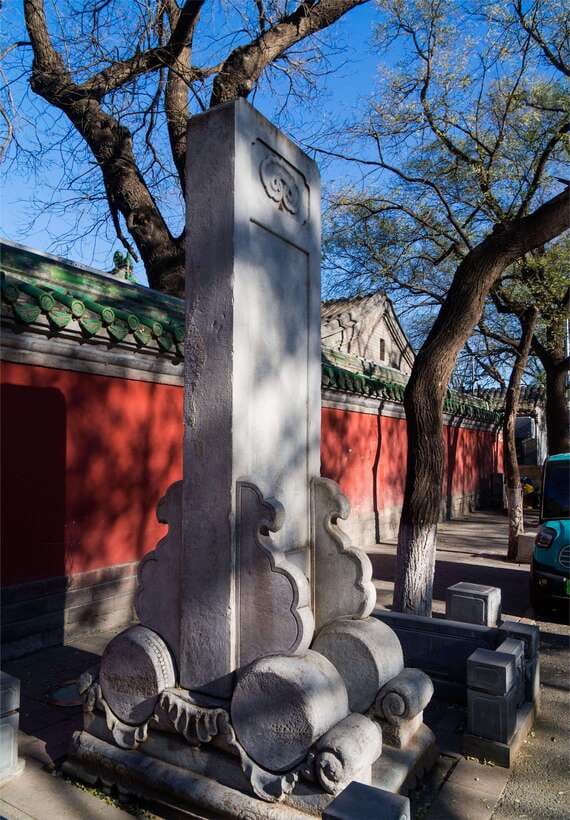
The stone tablets are the temple’s most unusual feature. There are 198 tablets, divided into four groups and placed on both sides of the front courtyard.
Together, they record 51,624 names, birthplaces, and ranks of people who passed the imperial examination. These inscriptions served as lasting records of success in a system that shaped Chinese government for centuries.
For you, the value is both historical and human. Each entry represents a person who passed a difficult examination and gained a place in the official system. The sheer number of names also shows how large and organized the system became.
The tablets are especially helpful if you have heard of the imperial examination but never understood its scale. Here, the subject is not reduced to a paragraph in a museum label. It is carved into rows of stone.
Do not expect every inscription to be easy to read or immediately meaningful without explanation. The information is valuable, but much of it is presented as names and records rather than as a dramatic story. This is where an audio guide could help. An audio guide may be purchased at the temple entrance, giving you more context as you move through the site.
If you are interested in Chinese history, education, government, genealogy, or calligraphy, plan to spend extra time here. If you mainly want grand halls and colorful decoration, the tablets may feel less immediately exciting. Their appeal grows when you understand what they represent.
Same city, a completely different day:
- From Beijing: Mutianyu Great Wall Tours with Options
★ 4.9 · 9,216 reviews - Beijing: T-Square & Forbidden City Group or Private Tour
★ 4.8 · 4,446 reviews - All-Inclusive Tour: Tiananmen Square, Forbidden City, Great Wall
★ 5.0 · 2,873 reviews - MuBus: Mutianyu Great Wall ENG/ESP/RUS Guided Bus Tour
★ 5.0 · 2,361 reviews
Three exhibitions inside the temple
The Confucius Temple currently has three exhibitions. One focuses on the restored Dacheng Hall. Another examines Confucius himself. The third tells the history of Beijing Confucius Temple.
These exhibitions give the visit more substance than a simple walk through historic courtyards. They provide three different angles: the building, the philosopher and teacher, and the institution in Beijing.
The exhibition about the Great Confucius helps place the temple within the wider Confucian tradition. The temple history exhibition explains how the site functioned over time. The restored hall display brings attention back to the architecture in front of you.
The information available does not specify the exhibition languages or the exact amount of English interpretation. If you do not read Chinese, check for an audio guide at the entrance. You may find the displays more useful with added explanation, especially if you want more than a quick photo stop.
I would treat the exhibitions as a reason to slow down. The temple buildings give you the setting, while the displays explain what the setting meant. Together, they make the visit easier to understand.
Crossing to the Imperial College
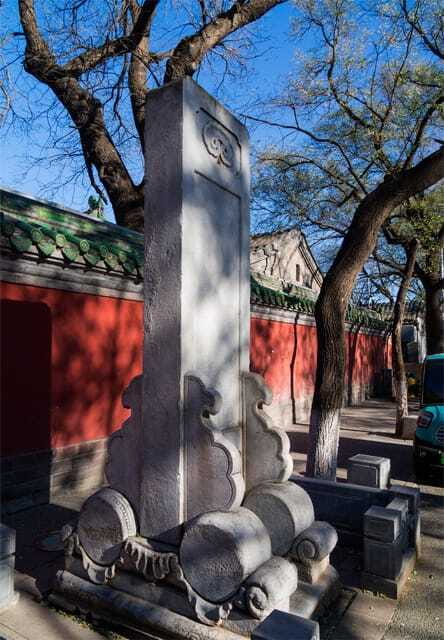
The second half of the visit is the Guozijian, or Imperial College. It was founded in 1308 during the Yuan Dynasty and served as the highest educational institution and state education office during the Yuan, Ming, and Qing dynasties.
The complex covers about 28,000 square meters and also has three courtyards. Its central axis includes:
- Jixian Gate
- Taixue Gate
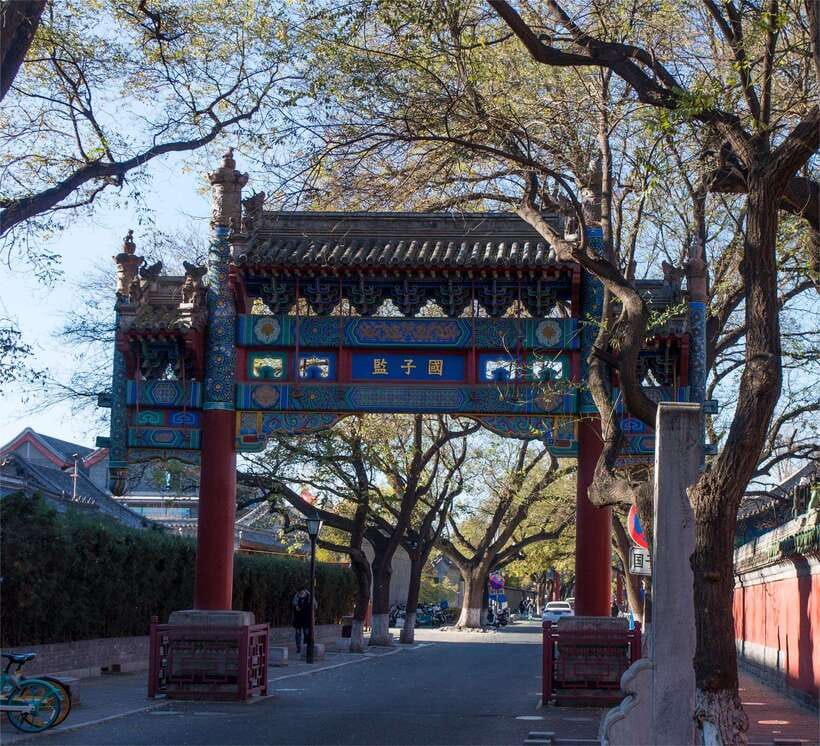
- Glazed Memorial Arch
- Biyong Hall
- Yilun Hall
- Jingyi Hall
Two halls, six main rooms, an Imperial Tablet Pavilion, and Bell and Drum Pavilions are arranged in a traditional symmetrical pattern beside the central axis.
The college adds an important counterpoint to the temple. At the Confucius Temple, you see the ceremonial honoring of Confucius. At the Imperial College, you see the institution connected with advanced education and state administration.
The glazed memorial arch is one of the features to watch for as you move through the college. The sequence of gates and halls again gives the site a formal rhythm. Symmetry matters here. The buildings were arranged to express order, discipline, and the importance of learning to government.
Biyong Hall is a key building in the college complex. The information provided does not give a detailed account of every hall’s original use, so it is best to treat the route as an architectural and institutional story rather than expect a fully narrated reconstruction of daily student life.
What the two sites explain together
The Confucius Temple and Imperial College work best as a pair. Visiting only one would give you part of the picture.
The temple shows the values and ceremonies associated with Confucius. The college shows the state’s education system and the official role of learning. The examination tablets connect them by recording the people who succeeded within that system.
This pairing is the real strength of the ticket. You can move from philosophy and ritual to education and government without leaving the historic complex. The visit also shows how architecture can express an idea. Straight axes, repeated courtyards, formal gates, and balanced halls all support the message that learning was orderly, serious, and tied to public service.
I find this more rewarding than a site that offers only attractive buildings. The buildings are important, but they are also clues. They help you see how Confucian thought influenced institutions, ceremonies, and careers.
How much time should you allow?
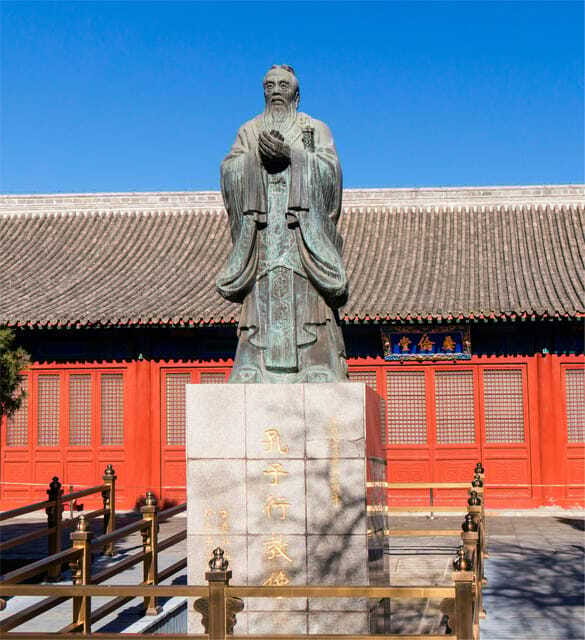
The ticket is valid for one day, and the advertised duration is one day. That gives you a flexible visit rather than a short, fixed appointment.
Your timing should depend on how you like to explore:
- Allow a shorter visit if you mainly want the architecture and a quick look at the main courtyards.
- Set aside more time if you want to read the exhibitions and study the examination tablets.
- Add time if you plan to use an audio guide purchased at the entrance.
No transport, meal, guide, or extra activity is included. This matters because the experience is best understood as a self-guided attraction ticket. You choose the pace, but you also take responsibility for making sense of the displays.
The private-group label does not turn this into a guided private tour. The included item is the attraction ticket. If having someone explain the site is important to you, confirm the exact arrangements before booking or plan to use the available audio guide.
Price, flexibility, and practical value
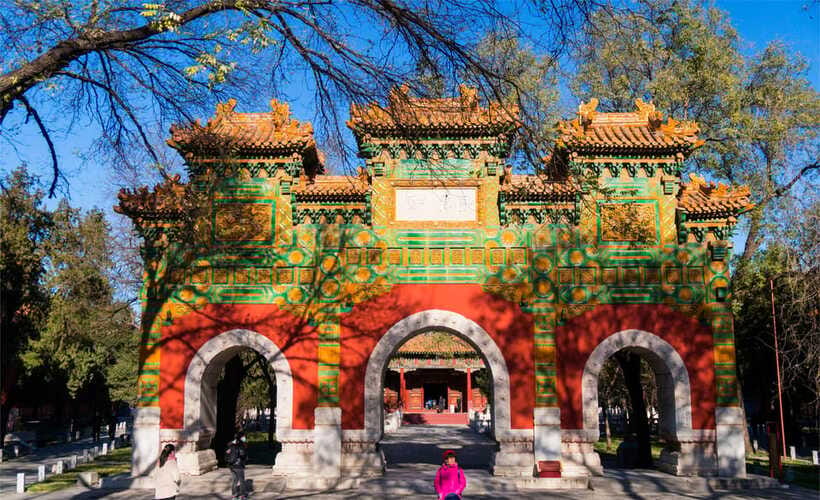
At $7, this is one of the easier Beijing history visits to justify. The ticket covers entry to both the Confucius Temple and Imperial College, and it remains valid for one day.
The value is strongest for independent visitors who want:
- Two connected historic institutions
- Yuan Dynasty architecture
- Exhibitions about Confucius and the temple
- A close look at the imperial examination records
- Flexible time without a fixed tour route
The value is less clear if you expect a fully guided experience. There is no guide listed among the included features, and the ticket covers admission only. You may need to pay separately for an audio guide at the entrance.
The booking also allows cancellation up to 24 hours before the visit for a full refund, and you can reserve now and pay later. Those terms are useful if your Beijing schedule is still changing. The most important practical step is to keep your original passport with you. Without it, the electronic ticket may not be enough for entry.
Who should book this experience?
I would recommend it to anyone curious about how education shaped imperial China. It is also a good choice for visitors who enjoy architecture, inscriptions, museums, and quiet historical sites more than high-energy attractions.
Students of Chinese history will find plenty to examine. Families with older children may appreciate the clear theme of study, exams, and official careers, though younger children may find rows of stone inscriptions less engaging.
It suits independent visitors especially well because the ticket is simple and flexible. You can pause at the tablets, move quickly through a courtyard, or spend more time with the exhibitions without keeping up with a group.
I would be more cautious if your main goal is a guided introduction to Beijing. The ticket does not include a named guide or a spoken tour. In that case, the audio guide option at the entrance becomes important, and you should not book this expecting a private historian.
Should you book the Confucius Temple and Imperial College ticket?
Book it if you want a low-cost, self-guided look at two connected institutions that explain education, ritual, and government in imperial China. The 51,624 examination records are the standout feature, while the Yuan Dynasty courtyards and three exhibitions give the visit shape.
Skip it if you want a guided tour, a packed schedule of activities, or a major royal palace experience. This is a thoughtful cultural stop, not a spectacle.
For $7, the combination is hard to fault. Bring your original passport, keep your QR code ready, and consider the audio guide if you want more context. If those simple arrangements suit you, this ticket offers a useful and affordable side of Beijing that many first-time visitors miss.
FAQ
What does the ticket include?
The ticket includes admission to Beijing Confucius Temple and the Imperial College, also called Guozijian.
How much does the experience cost?
The listed price is $7 per person.
How long is the ticket valid?
The ticket is valid for one day.
What do I need to bring for entry?
Bring your original passport or ID card, along with your electronic ticket and QR code. The entry instructions specifically require the original passport.
Is a guide included?
No guide is listed as included. An audio guide may be available for purchase at the entrance to the temple.
What can I see at the Confucius Temple?
You can see Yuan Dynasty architecture, three courtyards, ceremonial gates and halls, 198 examination tablets, and three exhibitions covering the restored Dacheng Hall, Confucius, and the history of Beijing Confucius Temple.
What can I see at the Imperial College?
The Imperial College includes three courtyards, the Glazed Memorial Arch, Biyong Hall, Yilun Hall, Jingyi Hall, an Imperial Tablet Pavilion, Bell and Drum Pavilions, and other traditional halls and rooms.
Is the attraction wheelchair accessible?
Yes. The attraction is listed as wheelchair accessible.
New reviews from Beijing
- Mutianyu Wall, Summer Palace & Old Summer Palace Day Tour★ 4.8 · 34 reviews
- Night Market Haggling Adventure with an English Guide!★ 4.8 · 7 reviews
- BusDa-Mutianyu Great Wall&Forbidden City Full-day Coach Tour★ 4.9 · 11 reviews
- Mutianyu Great Wall Ticket with Roundtrip Cable Car★ 5.0 · 20 reviews
- Mutianyu Great Wall Bus Trip+Ticket 7/8/9/10/13/13:30/15:30★ 4.7 · 24 reviews
- Mutianyu Great Wall Entry Ticket Chairlift Up Toboggan Slide★ 4.9 · 8 reviews
- Mutianyu Great Wall 5-KM Guided Hike with Uphill Cable Car★ 4.8 · 16 reviews
- Mutianyu Great Wall Admission Ticket★ 3.6 · 7 reviews
Tours in Beijing, compared.


Forbidden City Tour(Group/Private)-Tickets Included
Read our review →
T-Square & Forbidden City Group or Private Tour
Read our review →
All-Inclusive Tour: Tiananmen Square, Forbidden City, Great Wall
Read our review →
MuBus: Mutianyu Great Wall ENG/ESP/RUS Guided Bus Tour
Read our review →
4-Hour Small Group Tour to Forbidden City with Entry Tickets
Read our review →
Beijing Full Day Tours: Tiananmen Sq, Forbidden City, Great Wall
Read our review →