
Reviewed · SHOWS & PERFORMANCES
Hangzhou: Impression West Lake Show Enduring Memories of HZ
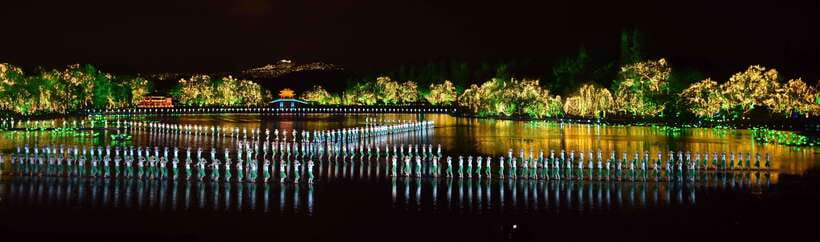
The magic begins with the stage itself: West Lake becomes part of the performance. Dancers move across shallow water and a floating platform while music, mist, and colored lights turn the night into a carefully arranged picture. I like the way the show uses Hangzhou’s own stories instead of placing a standard theater production beside the lake.
I also like the clean, one-hour format and the work of director Zhang Yimou, known for the 2008 Beijing Olympics ceremonies. The special auditorium is designed so regular seats still have a good view, though the $74 price is a serious spend for a performance that some viewers may find too short.
Key points to know before you go
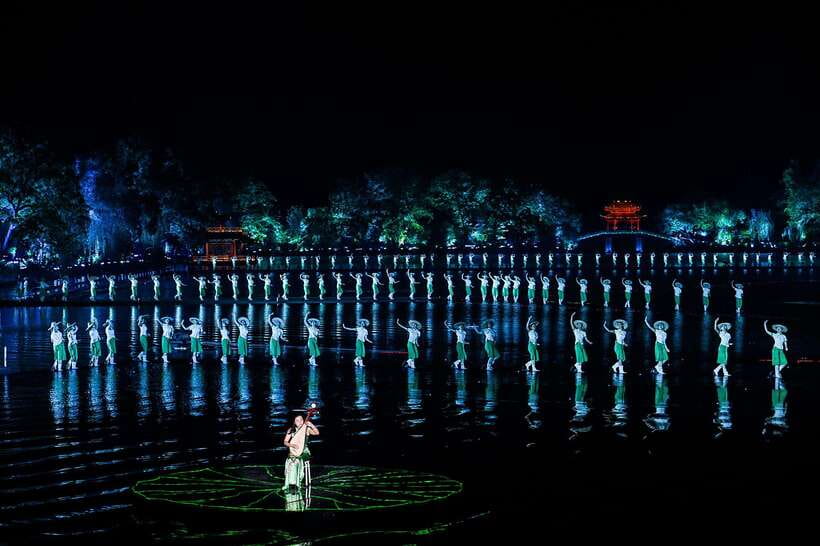
- The stage floats on West Lake, with dancers working in shallow water and on a platform.
- Zhang Yimou directs the production, which first gained international attention during the 2016 G20 Summit in Hangzhou.
- Nine acts combine Chinese legends, classical music, ballet, folk songs, and patriotic pieces.
- The show lasts one hour, making it easy to fit into an evening in Hangzhou.
- Your QR code may not be the final paper ticket: one booking reported an exchange at the counter before entry.
- Winter evenings are cold: bring heavy clothing from November through April.
Why Impression West Lake feels different
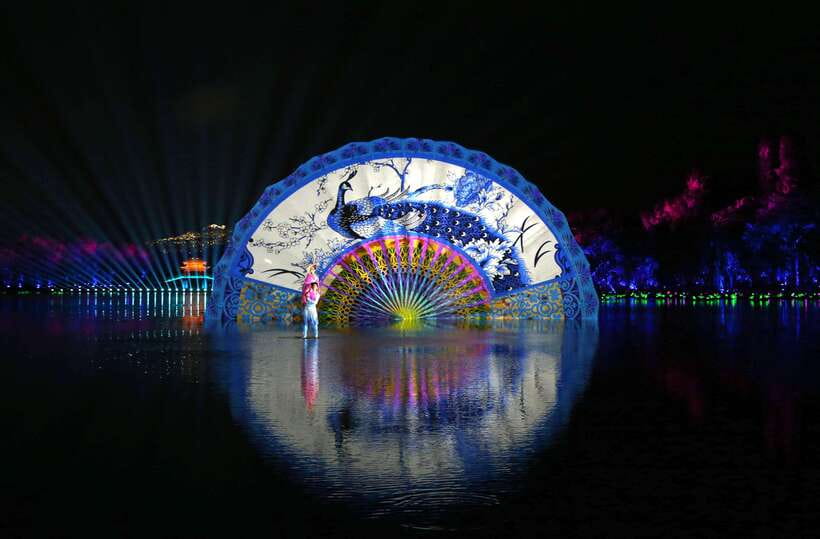
Many city performances use a stage to suggest a place. This one uses the place itself. The water of West Lake, the night sky, artificial mist, and the floating stage all work together, so the setting is not just decoration behind the dancers.
That choice gives the performance its strongest moments. A movement across shallow water can look simple in daylight, but with backlighting and music it becomes a striking image. The result is less like a conventional theater show and more like a series of moving pictures placed on the lake.
I also appreciate the scale. The show was created under Zhang Yimou’s direction, and his experience with large public ceremonies is easy to understand in the arrangement. Each section is short, visual, and easy to follow even if you do not know much about Chinese music or folklore.
The production was presented to leaders attending the 2016 G20 Summit as a signature presentation from Hangzhou. A new version, titled Enduring Memories of Hangzhou, opened to the public in May 2017. That background helps explain the polished staging and broad international appeal.
Still, you should set the right expectation. This is not a small folk performance with a local storyteller explaining every legend. It is a grand visual show. Music, movement, light, and scenery carry much of the meaning.
Other shows and performances in China:
- Red Theatre Beijing Acrobatic Show Tickets
★ 4.9 · 461 reviews - Shanghai: Circus World ERA Theatre Acrobatics Ticket
★ 4.9 · 283 reviews - Shanghai Circus World: ERA2 Intersection of Time Acrobatics Show
★ 4.5 · 235 reviews
Arriving at No. 82 Beishan Road
The meeting point is No. 82, Beishan Road, in Xihu District. That address matters because the performance is tied to a specific auditorium beside West Lake, not a general city theater.
Entry is intended to be simple. A QR code is sent by text message or email, and you show it at the gate. The digital entry process has been smooth for some bookings, but keep one practical detail in mind: one purchaser was asked to exchange the electronic ticket for a printed ticket at the counter.
I would save the QR code before leaving your hotel and allow enough time to find the correct entrance. The information provided does not give a required arrival time, transport instructions, or a detailed seating map, so do not assume the whole process works like a phone scan at a subway gate.
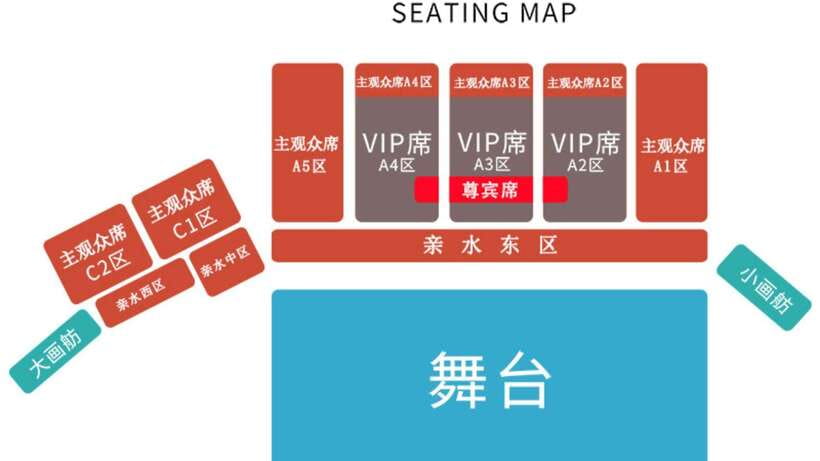
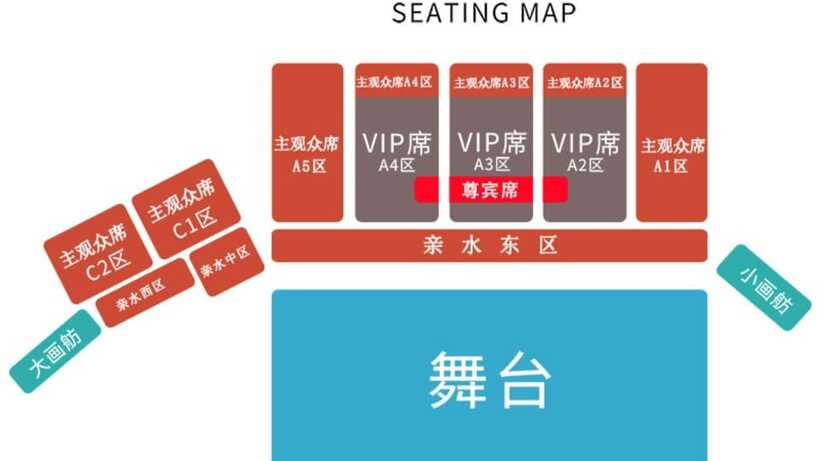
The auditorium is described as specially designed so each seat offers a good place to watch. VIP and regular seats are available. The exact difference between the classes is not supplied, so compare the price and seating options carefully before booking.
Act 1: Spring River in the Flower Moon Night
The opening act uses one of China’s ten traditional musical masterpieces. Spring River in the Flower Moon Night is a natural choice for a show set on water, with its title alone suggesting moonlight, flowing water, and a quiet evening.
As an opener, it establishes the mood rather than rushing into a dramatic story. The music gives the lake setting room to matter. You are watching a performance, but the water remains an active part of the picture.
This section will likely appeal most if you enjoy atmosphere and traditional Chinese music. If you prefer a clear plot from the first minute, the opening may feel more like a visual introduction than a story.
Act 2: Tea pickers in the green fields
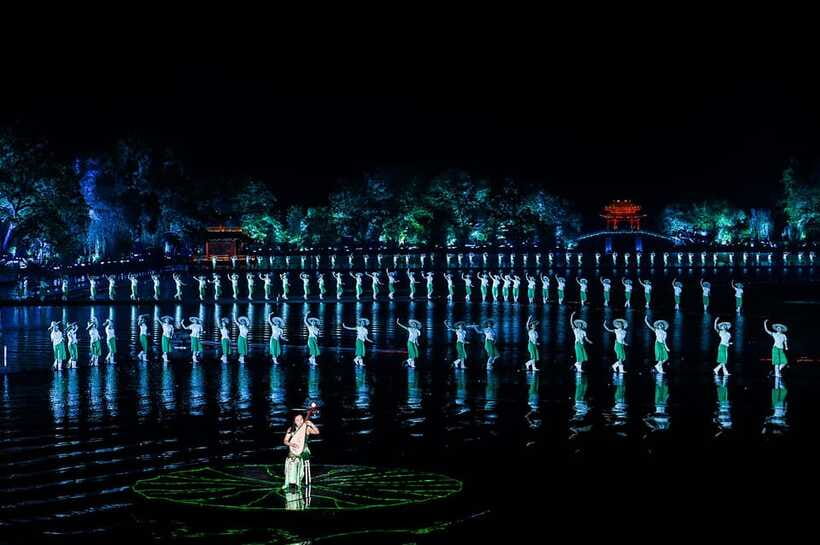
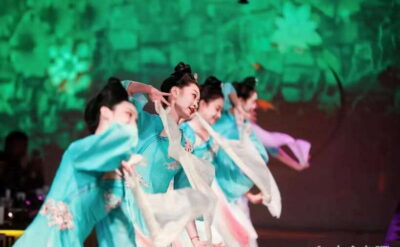
Dance of Picking Tea Leaves shifts from water to the tea-growing culture associated with Hangzhou. The dancers portray tea-picking girls gathering young tea buds in green tea fields.
This is one of the more local sections because it connects the show to a product and tradition strongly associated with the region. Hangzhou is known for Longjing tea, though the description of the act does not specifically name that tea. The point is the rhythm of careful handwork and the link between ordinary labor and stage movement.
I like this kind of scene because it gives the program a human scale. After the grand opening, the tea-picking sequence brings the focus down to gestures, group patterns, and the countryside around the city.
Same city, a completely different day:
- From Beijing: Mutianyu Great Wall Tours with Options
★ 4.9 · 9,216 reviews - Beijing: Forbidden City Tour(Group/Private)-Tickets Included
★ 4.8 · 7,974 reviews - Beijing: T-Square & Forbidden City Group or Private Tour
★ 4.8 · 4,446 reviews - Beijing: Mutianyu Great Wall Daily Tour with Ticket & Lunch
★ 5.0 · 3,056 reviews
Act 3: The butterfly lovers
The story of Liang Shanbo and Zhu Yingtai is often described as a Chinese counterpart to Romeo and Juliet. The couple loves each other but cannot marry because their families forbid it. After their deaths, they become butterflies and fly from the tomb together.
This act gives the production its clearest emotional story. Even without knowing the legend in advance, you can follow the basic pattern: love, family opposition, loss, and transformation.
The lake setting suits the tale’s final change. Water, mist, and lighting can make the ending feel dreamlike without requiring a complicated stage set. For many viewers, this will be the most accessible of the traditional stories because its central conflict is easy to understand.
Act 4: High Mountains and Flowing Waters
High Mountains and Flowing Waters draws from one of China’s ten classical string music masterpieces. Its theme is the natural movement of water through mountain country.
This piece is less about a character or plot and more about sound and motion. The dancers and staging interpret the relationship between mountains and water, while the music gives the act its shape.
It is also a good example of how the show links Chinese cultural references to the physical setting. The water under the stage is not an afterthought. It helps the production present an old musical idea in a modern outdoor format.
Act 5: Swan Lake on West Lake
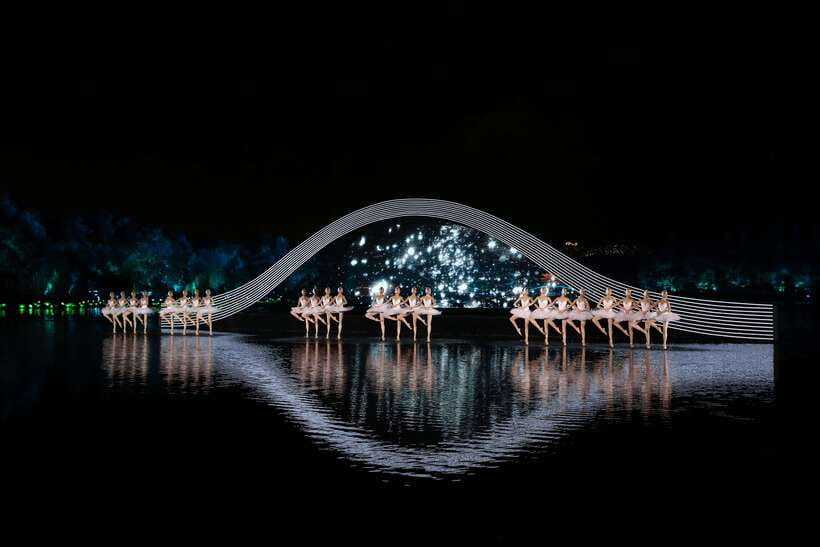
The program then shifts to a famous work from the Russian ballet tradition. Swan Lake is relocated to West Lake, creating a meeting point between Chinese staging and one of the world’s best-known ballets.
This is a smart change of pace. The earlier acts draw from Chinese legends, folk culture, and classical music. Swan Lake gives the audience a familiar international reference and shows that the production is meant to speak beyond China.
You should not expect a full-length ballet. This is one act inside a one-hour show, so the famous story and movement are presented in shortened form. If you want a complete Swan Lake production, this is not a substitute. If you enjoy seeing a familiar work reworked in an unusual setting, it is a welcome part of the program.
Acts 6 and 7: Country and moonlight
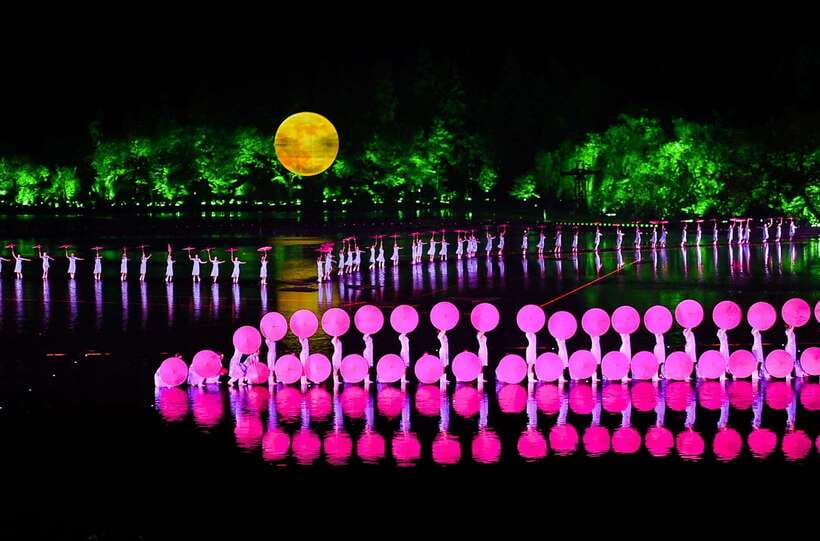
My Country and I expresses love of China and brings a patriotic tone to the program. It is more direct than the earlier legends and nature pieces, with the feeling of a public celebration.
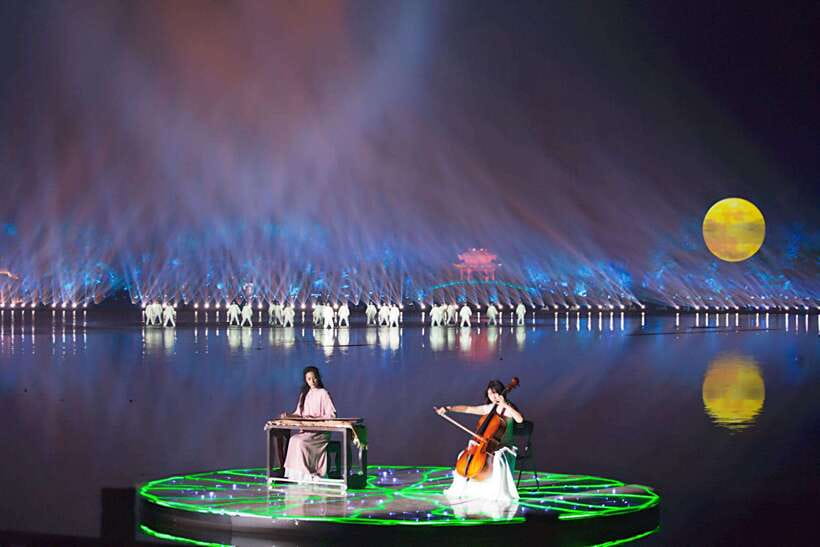
Moon Light returns to the lake itself. The act focuses on the moon reflected in the water and the mystery of West Lake at night. This is where the outdoor setting earns its keep again. The production can use darkness, reflection, and mist in ways an indoor theater cannot.
These two acts create a contrast. One looks outward toward national feeling; the other becomes quiet and reflective. The change may feel abrupt if you prefer a single continuous story, but it reflects the show’s format as a collection of themed scenes.
Acts 8 and 9: Jasmine Flower and Ode to Joy
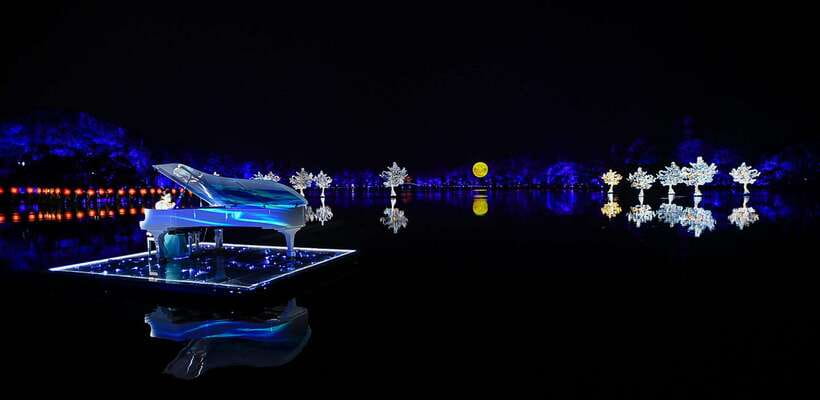
The Unforgettable Jasmine Flower uses one of China’s most widely recognized folk songs. Its international familiarity makes it another bridge between local culture and a worldwide audience.
The final act is Beethoven’s Ode to Joy. It brings the performance to its largest and most celebratory point, combining Western classical music with the water stage and full production effects.
Ending with Ode to Joy makes practical sense. It is instantly recognizable, strongly rhythmic, and built for a grand finish. You can expect the closing section to favor spectacle over subtle storytelling.
The nine acts are not connected by one continuous plot. Think of them as a sequence of cultural scenes. That structure lets the show move from Chinese tradition to ballet, folk song, patriotic music, and Western classical music without becoming too long.
Lights, music, mist, and the view from your seat
The technical production is a major reason to book this rather than seek out a standard indoor concert. The show uses a state-of-the-art sound system, lighting, and artificial mist. Those elements help turn simple movements into large images that can be seen across the auditorium.
The special seating design is meant to give each ticket holder a useful view. Regular seating should be enough for most people who mainly want to see the full arrangement. VIP seating may appeal if you place a high value on position, but the supplied details do not specify the exact distance, section, or added benefits.
The sound matters as much as the visuals. Traditional Chinese instruments, folk melodies, ballet music, Beethoven, and patriotic songs all require different treatment. A strong sound system helps keep the acts distinct instead of letting the outdoor setting swallow the music.
The main limitation is duration. One hour is convenient, especially if you are fitting the show around dinner or an evening walk beside West Lake. It also means each act has only a few minutes to make its point. One viewer found the show beautiful but a little short, and that is a fair concern at $74.
Is $74 a fair price?
At $74 per person, this is not a casual budget add-on. You are paying for a professionally produced evening performance, a purpose-built auditorium, the lake setting, and the name of Zhang Yimou. The value is strongest if you see the setting and production design as the main event.
The price is easier to justify for a first visit to Hangzhou, especially if you want one polished cultural performance rather than several smaller activities. The show was created as a high-profile presentation of the city, and it gives you a fast introduction to Chinese stories, tea culture, music, dance, and modern stage production.
The price is harder to justify if you want a long performance, a detailed spoken explanation, or a small local show. You should also check the available seating class before paying. VIP and regular tickets are both offered, but the exact differences are not described here.
The booking terms reduce some risk. You can cancel up to 24 hours ahead for a full refund, and you can reserve now and pay later. Availability depends on the selected starting time, so check the schedule before building the rest of your evening around it.
Who should book this show?
I would recommend it most strongly to first-time visitors who want a memorable night beside West Lake, families who enjoy visual performances, and anyone curious about Chinese legends without wanting a long lecture.
It also suits people who like large-scale music and dance productions. You do not need to know the stories in advance to appreciate the lights, water, movement, and music. The mix of Chinese and Western material gives the program a broad appeal.
You may want to skip it if you dislike symbolic performances, patriotic material, or short productions with many separate acts. It is also not the best choice if your main goal is a full ballet, an in-depth history lesson, or a low-cost evening activity.
For winter visits, dress warmly. A January booking specifically called for heavy clothing from November through April, and an outdoor setting beside water can feel cold at night. That advice is more important here than it would be for an indoor theater.
Should you book Impression West Lake?
I would book it if you want to see Hangzhou presented through water, music, and large visual scenes rather than through a standard theater show. The floating stage, moonlit setting, mist, and mixture of Chinese and Western works give it a clear identity.
I would pause if $74 feels high for one hour or if you need a tightly connected story. For most first visits, though, the short running time is also a benefit. You get a polished evening without sacrificing an entire night, and the show gives West Lake a role that no indoor performance could copy.
FAQ
Where is the Impression West Lake show held?
The meeting point is No. 82, Beishan Road, Xihu District, Hangzhou City.
How long does the show last?
The performance lasts one hour.
What does the ticket include?
The ticket includes admission to the show. Regular and VIP seat classes are available.
How do I enter the performance?
A QR code is sent by text message or email. You show the code at the gate. One booking required an exchange from an electronic ticket to a printed ticket at the counter, so check the entry instructions you receive.
Who directed the show?
The show was directed by Zhang Yimou, who also directed the opening and closing ceremonies of the 2008 Beijing Olympics.
Is the performance held on West Lake?
Yes. The stage is arranged on the water, with dancers performing in shallow water and on a floating platform.
What music appears in the show?
The program includes Spring River in the Flower Moon Night, High Mountains and Flowing Waters, Swan Lake, My Country and I, The Unforgettable Jasmine Flower, and Beethoven’s Ode to Joy.
Does the show tell the story of Liang Shanbo and Zhu Yingtai?
Yes. One act presents their tragic love story, including their transformation into butterflies after death.
Is the show available with free cancellation?
Yes. You can cancel up to 24 hours in advance for a full refund.
Can I reserve without paying immediately?
Yes. The reserve-now, pay-later option lets you hold a place without paying at the time of booking.
New reviews from China
- Shanghai: 3-Hour Old Shanghai City Tour★ 4.9 · 45 reviews
- Sichuan: Big Panda Volunteer Day tour★ 4.4 · 10 reviews
- Nanjing:Must-See Attractions in One Day+Customized Itinerary★ 5.0 · 3 reviews
- Mutianyu Wall, Summer Palace & Old Summer Palace Day Tour★ 4.8 · 34 reviews
- Night Market Haggling Adventure with an English Guide!★ 4.8 · 7 reviews
- BusDa-Mutianyu Great Wall&Forbidden City Full-day Coach Tour★ 4.9 · 11 reviews
- Mutianyu Great Wall Ticket with Roundtrip Cable Car★ 5.0 · 20 reviews
- Nanjing: Night Cruise on Outer Qinhuai River for Adults★ 4.0 · 4 reviews
Shows & Performances, compared.
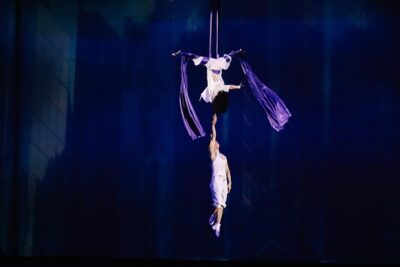
Shanghai Circus World: ERA2 Intersection of Time Acrobatics Show
Read our review →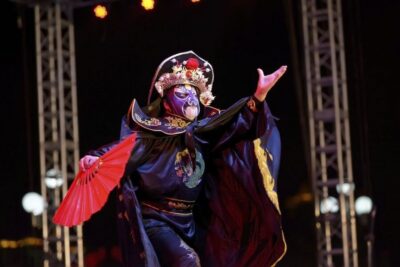
Sichuan Opera Shu Feng Yan Yun Evening Show Ticket
Read our review →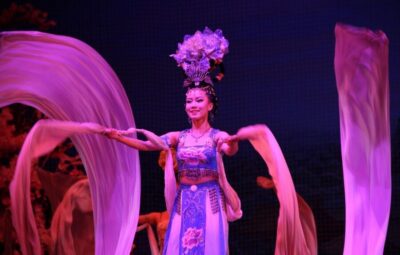
Great Tang Dynasty Night Show & Dumpling Meal Option
Read our review →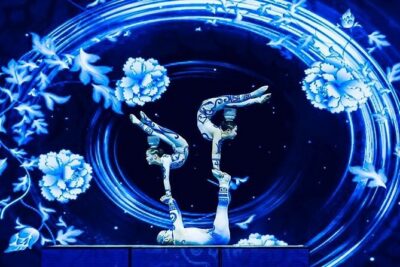
Royal Banquet with Chinese Cultural Performance
Read our review →
Beijing Roast Duck Banquet and Acrobatics Show with VIP Seats Evening Tour
Read our review →Browse the lists this tour appears in